
TOwCmtFIEL(1)

Hans Weber receives SPE award for 3D printed automotive component

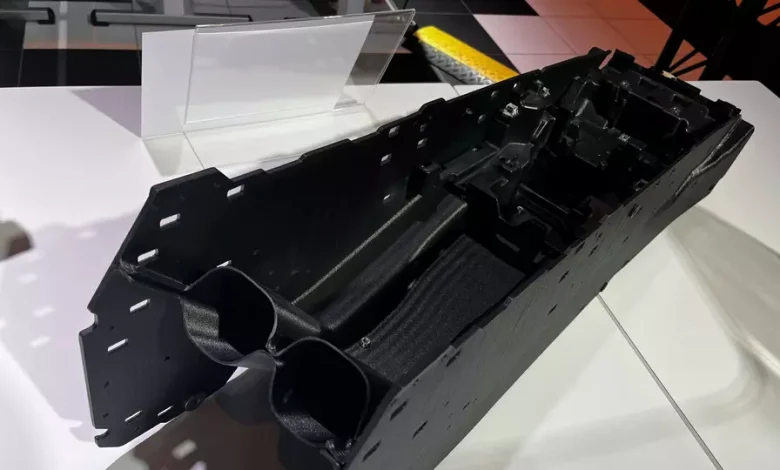
Hans-Weber-BMW-SPE-speaward2024_bmw_mittelkonsolentraeger
The end use component for serial manufacturing was developed in collaboration with BMW and LFAM printed using composite Akromid.

🌟Content in this article

A 3D printed automotive center console carrier component received the top SPE Automotive Award, highlighting numerous innovations and a clear trend toward sustainability. With this center console carrier for a BMW small-series project, a 3D printed component, made using robotic LFAM technology from Hans Weber, received the Grand Award of the renowned SPE Automotive Award for the first time in history.

The high-strength, large, and highly integrated 3D printed component was made from recycled carbon fiber and Akromid, a polymer derived from renewable raw materials. It replaces seven conventional parts and significantly reduces the vehicle’s carbon footprint by 70 kg.

For the 22nd time, the Society of Plastics Engineers (SPE) Central Europe awarded the Automotive Award for the most innovative plastic parts in vehicle construction. For the first time, a 3D printed component scored the highest points in the extensive evaluation process: the overall winner of the 2024 Automotive Award and the Grand Award was a 3D-printed center console carrier from BMW.

A comparison between the 3D printed component and the traditional manufactured one. The 3D printed piece replaces seven conventional parts and significantly reduces the vehicle’s carbon footprint by 70 kg.

The German automaker has been investing significantly for over a decade to increase the utilization of AM in its production processes (via custom tools) and to directly manufacture final parts, across many of its plants. At the “Additive Manufacturing Campus” in Oberschleißheim, the BMW Group’s central hub for production, research and training in 3D printing, more than 300,000 parts were “printed” in 2023. Furthermore, over 100,000 printed parts were produced per year across all the plants that form the global production network, from Spartanburg and the German plants to sites in Asia.

For its production, Hans Weber Maschinenfabrik used robot-based LFAM for an automotive series project for the first time. A major advantage of this process is that highly filled fiber-reinforced injection molding granulate can also be processed. A

dditionally, an intelligent component design reduced the number of parts from seven to one and integrated additional functions into the center console carrier. Not only the load-bearing structure but also integrated air channels for the rear passenger compartment’s climate control were printed in one process step. As another key highlight, the material—an Akromid from Akro-Plastic with 40% recycled carbon fiber—is based on renewable raw materials, reducing the CO2 footprint by an impressive 70 kg per component.

Have parts to make? Get free instant quote today.

Share the Post:

Related Posts

Knowledge Base
Stainless Steel 304: Comprehensive Analysis of Performance, Applications, and Selection Guide

Step into a modern kitchen, open a refrigerator, walk into an office building elevator, or observe medical equipment—in these seemingly different scenarios, one material silently underpins our lives: Stainless Steel 304. As the most common and widely used grade of austenitic stainless steel, SS304 has become an “invisible champion” in industrial manufacturing and daily life, thanks to its excellent corrosion resistance, good formability, and outstanding hygienic properties.
Since stainless steel was invented in the early 20th century, 304 stainless steel has evolved into the world’s most popular stainless steel variety, accounting for approximately 50% of the stainless steel market share. From aerospace to food processing, from architectural decoration to medical devices, this alloy occupies an irreplaceable position in modern materials science due to its unique combination of properties. This article will provide a comprehensive analysis of the chemical composition, mechanical properties, application fields, processing techniques, and selection guidelines for 304 stainless steel, offering a thorough reference for engineers, designers, purchasers, and general consumers.

Read More

Join our newsletter to stay updated

Scroll to Top