🏮 Holiday Notice – Mid-Autumn Festival & National Day
Dear Valued Customer,
As China's Mid-Autumn Festival (September 25–27) and National Day Holiday (October 1–7) are approaching, our production and logistics operations will be affected during this period. 🏮✨
📦 Orders Placed by September 30
😊 Priority Handling Orders placed on or before September 30 will be given priority.
🚚 Production & Shipping Arrangement We will do our best to arrange production before the holiday and ship your orders as soon as possible after the holiday.
⏰ Orders Placed During October 1–7
🕒 Additional Lead Time Orders placed between October 1 and October 7 may experience an additional lead time of approximately 8–10 days due to the holiday schedule.
🚀 Planning an Upcoming Project?
📅 Order in Advance If you have an upcoming project, deadline, or time-sensitive order, we recommend placing your order in advance to help avoid potential delays.
💛 Thank You for Your Understanding
Thank you very much for your understanding, patience, and continued support. We truly appreciate your trust in us and will continue doing our best to provide you with reliable service.
🌕Wishing you all a smooth and successful work schedule, and good health and happiness to you and your family!
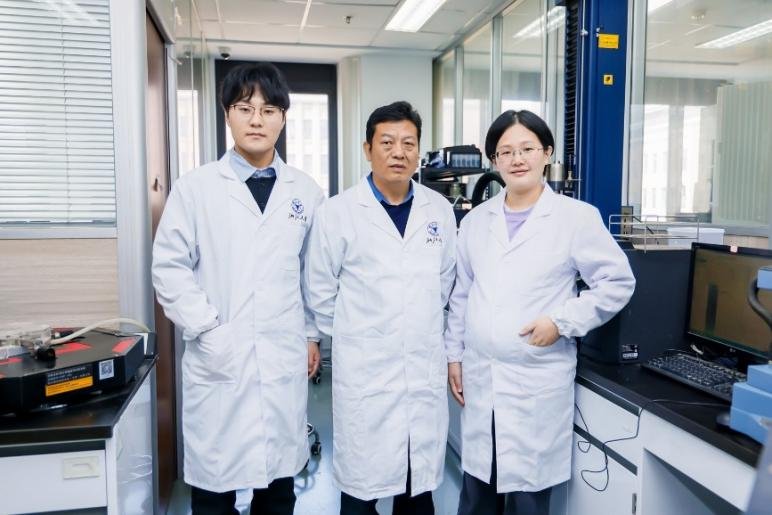
A research team from China’s Zhejiang University has developed an infinitely recyclable 3D printing resin based on a thermally reversible photo-click reaction. Led by PhD student YANG Bo and Professors XIE Tao and ZHENG Ning from the College of Chemical and Biological Engineering, the innovation supports ongoing efforts to advance a circular economy within additive manufacturing by enabling complete material recovery without compromising performance.
A Surprising Discovery in Thiol-Aldehyde Chemistry
Published in Science on April 11, the team describes how the breakthrough emerged unexpectedly during routine experimentation on photocurable 3D printing, in which production speed, material strength and resin costs were being tackled. While working with a thiol reagent, YANG Bo observed results that contradicted their initial hypothesis. “The reaction behaved the opposite of what we predicted,” he recalls. Further analysis revealed that a light-triggered click reaction had occurred between thiols and aldehydes—a process previously thought to require heat.
“This was the first time anyone showed that this reaction could occur rapidly under light,” says ZHENG Ning. He stressed this finding laid the foundation for a new class of recyclable, high-performance 3D printing resins.
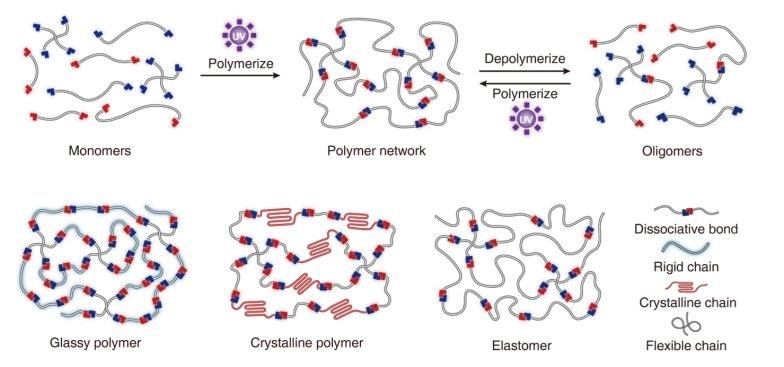
Modular polymer network design. Image via ZJU.
Traditional 3D photoprinting depends on photopolymerizing (meth)acrylate monomers and cross-linkers, which form stable carbon–carbon bonds that are nearly impossible to reverse for recycling. In contrast, XIE Tao’s team designed a system that forms dithioacetal bonds—molecular “clips” that can be assembled under light and disassembled with gentle heat, allowing the material to revert to its base components.
“It’s like disassembling Legos,” explains XIE Tao. “The printed object can be recovered at the molecular level and reprinted again and again.”
A Modular, Tunable Resin Platform
The resin system’s modular design is one of its most promising features. By fine-tuning the polymer backbone, the researchers successfully created a range of materials—including elastomers, crystalline polymers, and rigid plastics—without sacrificing recyclability. Potential applications include lost-foam casting for metal parts and orthodontic aligners.
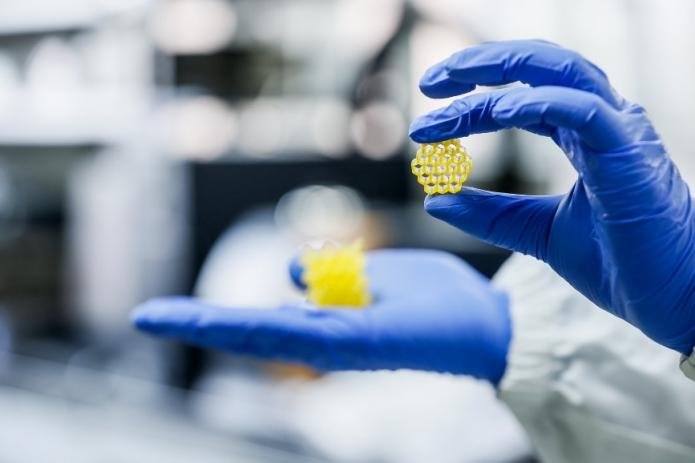
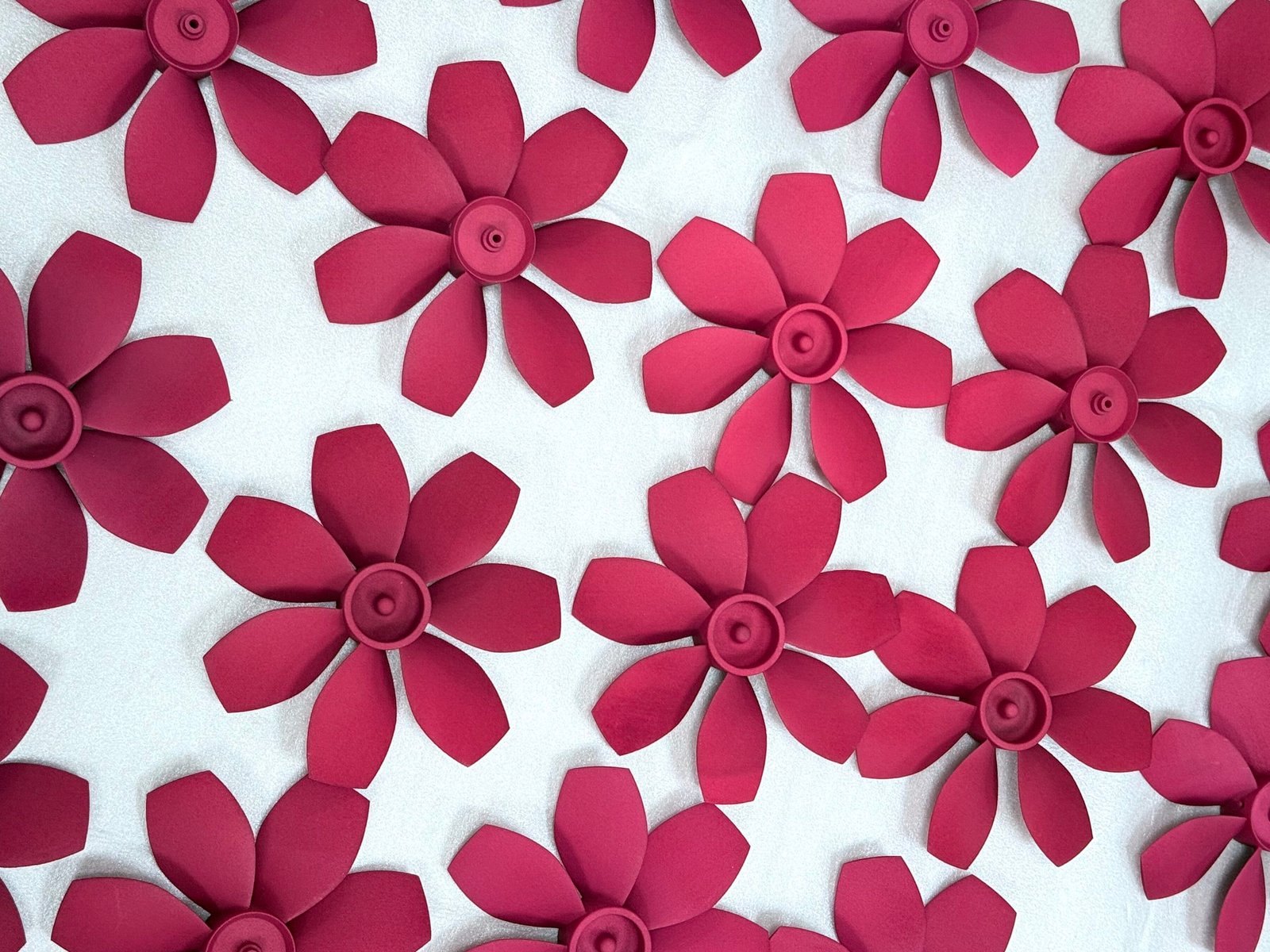
Infinitely Recyclable Resin. Photo via ZJU.
Our research has successfully overcome the longstanding trade-off between mechanical performance and closed-loop recyclability in photocurable 3D printing materials at the molecular level,” said XIE Tao. “By establishing a light-responsive dynamic dithioacetal chemistry system, we offer a novel molecular design strategy, providing meaningful insights for advancing sustainable manufacturing technologies.”
Recycling Efforts in Additive Manufacturing
This week, global automotive manufacturer BMW Group announced it is advancing its circular economy goals by repurposing waste from its additive manufacturing processes. At the Additive Manufacturing Campus in Oberschleißheim, Germany, and other sites worldwide, used 3D printing powder and components are recycled into filament for the Fused Filament Fabrication (FFF) process and granulate for Fused Granulate Fabrication (FGF), enabling the creation of new tools and parts.
This project will focus on developing methodologies for reutilizing and recycling AM materials. It will explore strategies for material recovery, lifecycle assessments, and frameworks to help manufacturers adopt eco-friendly practices without compromising part performance or reliability. The research will build on ASTM’s expertise in AM standards, qualification, certification, and sustainability, ensuring that the findings contribute to industry-wide best practices and regulatory guidelines.