🚀 July 11 Update – Batch Edit, Re-Quote, Tiered Pricing & Notifications Are Here
Dear Valued Customer,
We've just released another major update with improvements across the Instant Quote, Cart, Checkout, Dashboard, and Order Management.
As we're continuously shipping new features, there may still be occasional bugs or unexpected issues. If you find anything that doesn't work as expected, please let us know—we truly appreciate your feedback and will fix it as quickly as possible.
🛠 Instant Quote
🏷 Material Tags added to help you choose the most suitable material. 📊 Tiered Pricing is now available. Instantly compare quantity discounts and select the best pricing option. ✏️ Batch Edit for multiple parts. Update configurations or delete multiple parts at once.
🛒 Cart
🔄 Re-Quote any part directly from your cart and continue editing before placing your order. 🛍 Mini Cart added to the header, allowing you to quickly view your cart from any page.
📦 Orders
♻️ Add to Quote and Add All to Quote are now available for existing orders. Reuse previous parts, make changes, and generate a new quote in just one click.
💳 Checkout
🌍 Customs & Shipping Options added.
Choose how you want customs declaration handled. Set your preferred Customs Value. Tell us your Expected Shipping Date.
🔔 Dashboard
🔔 Notifications keep you updated on order status and important activities. 📢 Announcements provide the latest ProtoTi news and product updates.
⚡ Performance & Improvements
We've also fixed and optimized numerous issues across:
Instant Quote
Checkout
Order Details
making the overall experience smoother and more reliable.
💬 Found a bug or have a feature request?
We're releasing new features rapidly, and your feedback helps us improve faster.
Justin Bieber’s fashion label Skylrk is expanding into 3D printed footwear with its first printed sneaker, the Earth Bender, developed in collaboration with 3D printing footwear company Zellerfeld using its advanced manufacturing platform.
Skylrk Debuts the 3D Printed Earth Bender
Skylrk’s first AM silhouette is produced using Zellerfeld’s full-stack 3D printing system. The model debuted in a Lilac colorway and was available exclusively last weekend at the brand’s temporary Tokyo pop-up; Skylrk’s first-ever physical retail space.
The sneaker embodies Skylrk’s design DNA: comfort-driven shapes, bold color expression, and a drop-to-drop evolution of form. Drawing inspiration from soccer cleats, it features an overturned tongue and a sculptural, futuristic profile. An additional Oat version was present at the pop-up for try-ons only.
Bieber’s Ongoing Link to Zellerfeld
Bieber has previously stepped out in Zellerfeld-made footwear, most notably the fully recyclable Nami sneaker, created by Finn Rush-Taylor Studio in collaboration with Zellerfeld, which he wore to a League basketball game in Los Angeles in October.
Since launching in July, Skylrk has also leaned heavily into futuristic design language, releasing sculptural mules, slides, and other experimental silhouettes across multiple colorways. Several additional 3D printed designs are already in development through the brand’s continued partnership with Zellerfeld.
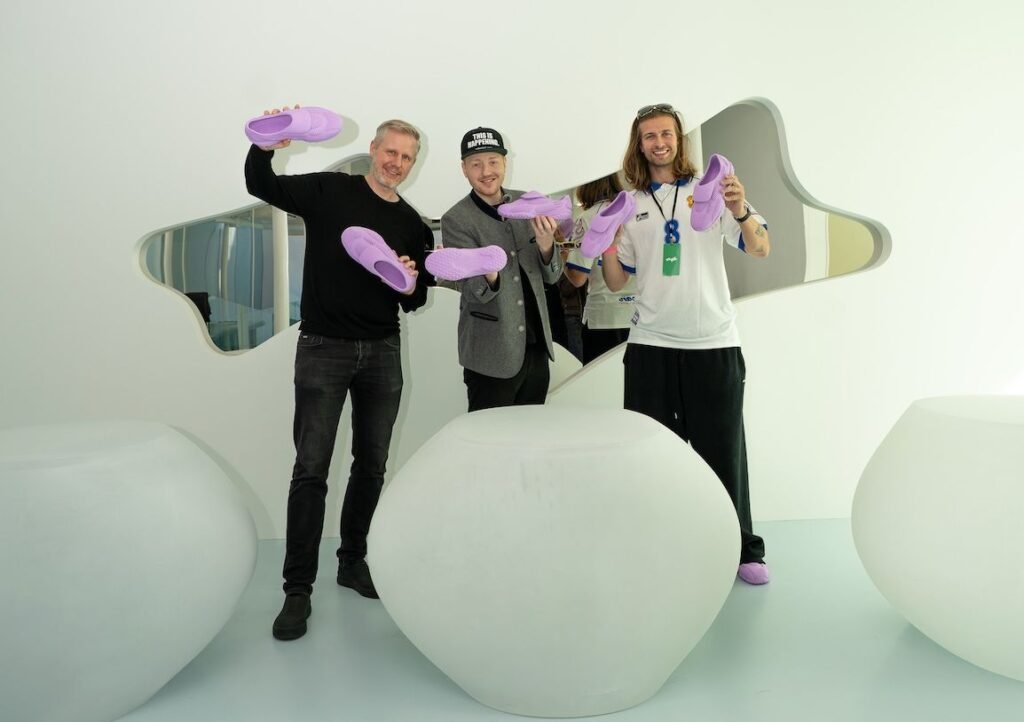
The Zellerfeld team at the 3D printed sneaker launch event. Photo via Zellerfeld.
Recent collaborations highlight how Zellerfeld’s technology is being applied across fashion and luxury markets.
In July, Hugo, a sub-label of Hugo Boss, released a loafer-style shoe developed with Zellerfeld. Produced as a single unit using the company’s proprietary software and hardware, the HUGO FORWARD x Zellerfeld model eliminates traditional sizing, assembly, and inventory requirements. The result is a custom-fitted shoe manufactured within hours and designed with circularity in mind.
Zellerfeld also worked with designer Sean Wotherspoon—known for his use of unconventional materials and focus on sustainability—to introduce the Sean Double U collection, featuring a sneaker and a mule. Both pieces are produced in one piece without adhesives or stitching, underscoring the environmental benefits of additive manufacturing.
In March, UK luxury brand Mallet London partnered with Zellerfeld to launch the Nebula, its first 3D printed shoe. Based on Mallet’s Neptune silhouette, the design was reimagined through Zellerfeld’s automated process to deliver greater design flexibility, faster turnaround, and improved material efficiency.
*This article originally appeared on [3dprintingindustry]. [PALOMA DURAN] is the original author of this piece.