


TOwCmtFIEL(1)

Saab and Divergent produce 5-meter 3D printed aircraft fuselage for 2026 flight test

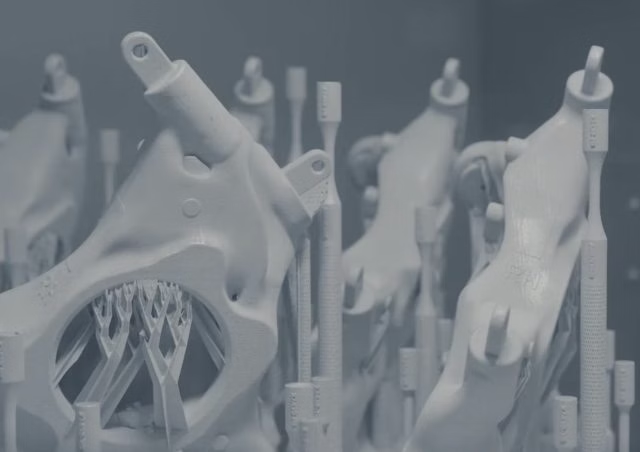
Saab AB and Divergent Technologies have completed a fully additively manufactured aircraft fuselage measuring five meters in length, built using Divergent’s software-defined manufacturing system. The structure, made entirely without molds or rivets, represents one of the largest metal components yet produced through additive manufacturing for powered flight.

Kevin Czinger founded Divergent and began by printing automotive frames for what would become the Czinger 21C over a decade ago, when no one else thought it would be feasible or cost-effective. By demonstrating that AM could be used to print an entire car frame, he set the benchmark for printing anything else. If you can print a frame for a supercar, then printing a larger frame for a plane is no longer a theoretical question but “simply” an engineering problem. It has now been solved.

Axel Bååthe, Head of Saab’s Rainforest initiative, described the project as a milestone in the company’s digital transformation efforts. “Adopting Divergent’s additively manufactured and digitally designed structures in this effort has given our joint team unparalleled flexibility in this development process,” Bååthe said. “We see digital design and advanced manufacturing as a key enabler of our collaborative success in this project.”

The 15-foot (5-meter) fuselage, intended to fly as part of an autonomous airborne platform in 2026, represents one of the largest metal airframe sections ever built through additive manufacturing for powered flight. The structure was developed without any unique tooling or fixturing, relying instead on the Divergent Adaptive Production System, an end-to-end structural design and manufacturing platform that combines AI-driven engineering, industrial-rate additive manufacturing, and fixtureless robotic assembly. DAPS enables faster development cycles, improved structural performance, and lower production costs compared with conventional aerospace manufacturing methods.

The completed structure consists of 26 unique laser powder bed fusion parts, joined and bonded in Divergent’s fixtureless robotic assembly cell. The companies report that the project demonstrates the scalability of Divergent’s technology for complex, high-performance aerospace applications, achieving 99% fewer parts and about 45% less weight than traditional designs.

“This collaboration with Saab highlights what becomes possible when ambitious aircraft concepts are paired with an end-to-end, software-defined manufacturing platform,” said Lukas Czinger, Co-founder and CEO of Divergent. “By tightly integrating digital design, additive manufacturing, and automated assembly, our teams were able to realize a large-scale fuselage structure aligned with Saab’s vision, while moving with a level of speed, flexibility, and structural integration that traditional approaches cannot match.”

*This article originally appeared on VoxelMatters. Davide Sher is the original author of this piece.

Have parts to make? Get free instant quote today.

Share the Post:

Related Posts

Knowledge Base
Stainless Steel 304: Comprehensive Analysis of Performance, Applications, and Selection Guide

Step into a modern kitchen, open a refrigerator, walk into an office building elevator, or observe medical equipment—in these seemingly different scenarios, one material silently underpins our lives: Stainless Steel 304. As the most common and widely used grade of austenitic stainless steel, SS304 has become an “invisible champion” in industrial manufacturing and daily life, thanks to its excellent corrosion resistance, good formability, and outstanding hygienic properties.
Since stainless steel was invented in the early 20th century, 304 stainless steel has evolved into the world’s most popular stainless steel variety, accounting for approximately 50% of the stainless steel market share. From aerospace to food processing, from architectural decoration to medical devices, this alloy occupies an irreplaceable position in modern materials science due to its unique combination of properties. This article will provide a comprehensive analysis of the chemical composition, mechanical properties, application fields, processing techniques, and selection guidelines for 304 stainless steel, offering a thorough reference for engineers, designers, purchasers, and general consumers.
Read More

Join our newsletter to stay updated

Scroll to Top