🚀 July 11 Update – Batch Edit, Re-Quote, Tiered Pricing & Notifications Are Here
Dear Valued Customer,
We've just released another major update with improvements across the Instant Quote, Cart, Checkout, Dashboard, and Order Management.
As we're continuously shipping new features, there may still be occasional bugs or unexpected issues. If you find anything that doesn't work as expected, please let us know—we truly appreciate your feedback and will fix it as quickly as possible.
🛠 Instant Quote
🏷 Material Tags added to help you choose the most suitable material. 📊 Tiered Pricing is now available. Instantly compare quantity discounts and select the best pricing option. ✏️ Batch Edit for multiple parts. Update configurations or delete multiple parts at once.
🛒 Cart
🔄 Re-Quote any part directly from your cart and continue editing before placing your order. 🛍 Mini Cart added to the header, allowing you to quickly view your cart from any page.
📦 Orders
♻️ Add to Quote and Add All to Quote are now available for existing orders. Reuse previous parts, make changes, and generate a new quote in just one click.
💳 Checkout
🌍 Customs & Shipping Options added.
Choose how you want customs declaration handled. Set your preferred Customs Value. Tell us your Expected Shipping Date.
🔔 Dashboard
🔔 Notifications keep you updated on order status and important activities. 📢 Announcements provide the latest ProtoTi news and product updates.
⚡ Performance & Improvements
We've also fixed and optimized numerous issues across:
Instant Quote
Checkout
Order Details
making the overall experience smoother and more reliable.
💬 Found a bug or have a feature request?
We're releasing new features rapidly, and your feedback helps us improve faster.
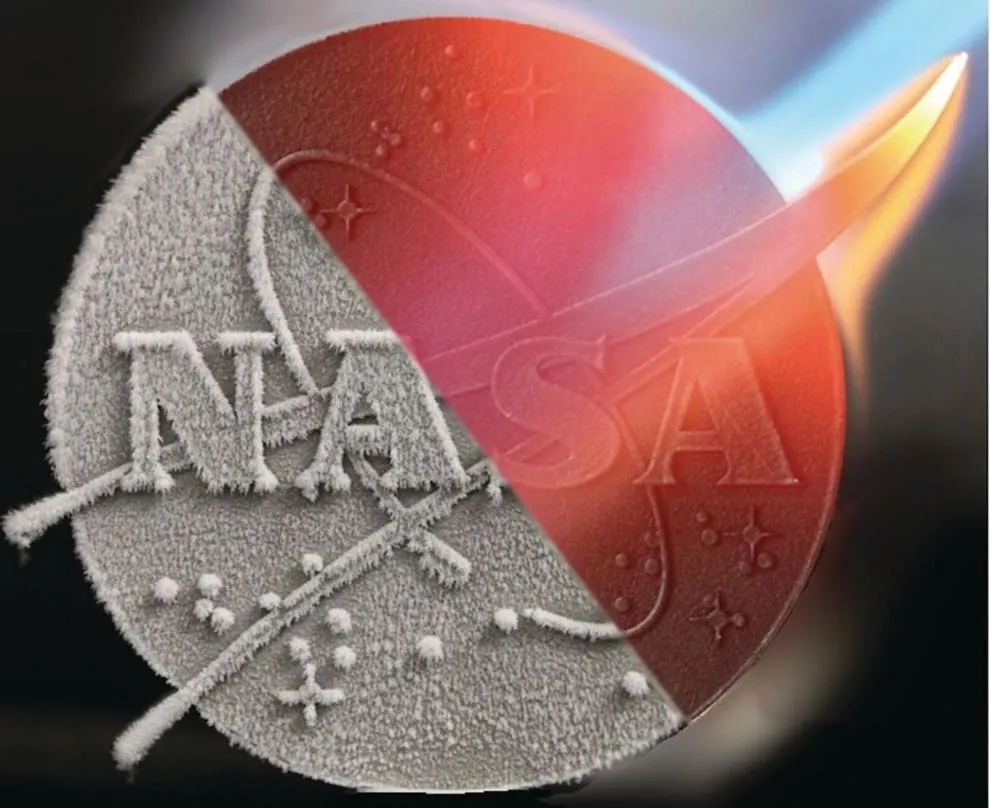
The GRX-810 alloy, developed by NASA’s Glenn Research Center, addresses a key limitation in 3D printing for spacecraft: the lack of cost-effective materials that can withstand extreme temperatures. The alloy is a blend of nickel, cobalt, and chromium, enhanced by a ceramic oxide coating that increases heat resistance and improves performance. Its characteristics classify it as an oxide dispersion strengthened (ODS) alloy, which were previously challenging and costly to manufacture.
NASA’s team developed a unique resonant acoustic mixing technique to produce this material. This process applies rapid vibration to the metal powder and nano-oxide particles, creating a permanent bond that ensures the ODS qualities are retained, even if the material is recycled. The alloy’s performance is a notable improvement over other options, capable of enduring stress at 2,000°F for up to a year. This also allows for the creation of more complex shapes than traditional manufacturing methods.
Commercialization & Applications
The GRX-810 alloy is now being produced and distributed by U.S.-based 3D printing metal alloy provider Elementum 3D, a company that holds a co-exclusive license for the NASA-patented technology. The partnership between NASA and the company continues under a Space Act Agreement to further improve the material.
“A material under stress or a heavy load at high temperature can start to deform and stretch almost like taffy,” said Jeremy Iten, chief technical officer with Elementum 3D. “Initial tests done on the large-scale production of our GRX-810 alloy showed a lifespan that’s twice as long as the small-batch material initially produced, and those were already fantastic.”
The commercial space and aviation industries are exploring various applications for GRX-810. For instance, Elementum 3D’s client Vectoflow, a specialist in advanced fluid-dynamic measurement technology is testing a flow sensor made from the alloy. These sensors monitor the speed of gases in a turbine and often fail in high-temperature environments. Using GRX-810 could improve fuel efficiency, reduce emissions and decrease the need for replacements.
Recent Developments in NASA’s 3D Printing Technology
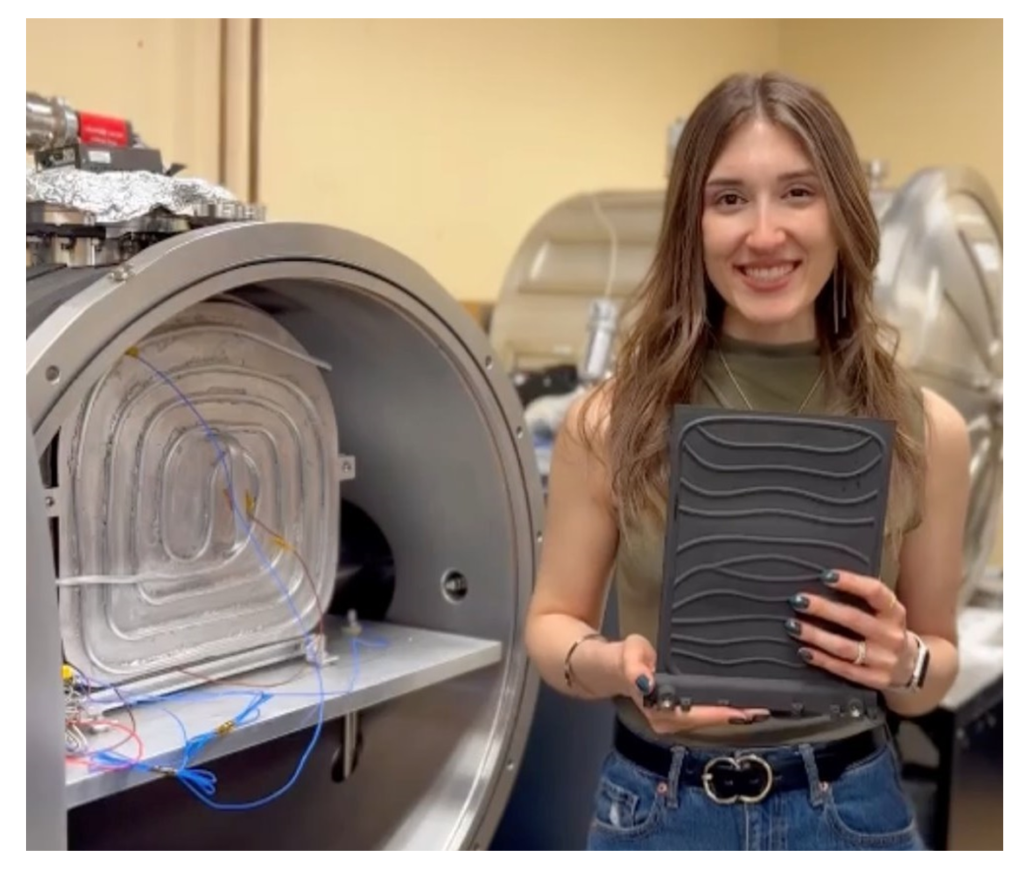
PSU PhD candidate, Tatiana El Dannaoui, installing radiator prototype in thermal vacuum test facility to simulate space environment operation. Photo via PSU.
Administered by FAMU, the project involves collaboration with faculty members from FSU, the Goddard Space Flight Center, and FAMU. Led by Professor Subramanian Ramakrishnan from the Department of Chemical and Biomedical Engineering, the team featuring Richard Liang, Emily Pritchard, Satyanarayan Dev, and Margaret Samuels, is working on single-step systems that integrate sensing materials and electrodes to improve manufacturing efficiency and device quality.
*This article originally appeared on 3D Printing Industry. Paloma Dura is the original author of this piece.