🚀 July 11 Update – Batch Edit, Re-Quote, Tiered Pricing & Notifications Are Here
Dear Valued Customer,
We've just released another major update with improvements across the Instant Quote, Cart, Checkout, Dashboard, and Order Management.
As we're continuously shipping new features, there may still be occasional bugs or unexpected issues. If you find anything that doesn't work as expected, please let us know—we truly appreciate your feedback and will fix it as quickly as possible.
🛠 Instant Quote
🏷 Material Tags added to help you choose the most suitable material. 📊 Tiered Pricing is now available. Instantly compare quantity discounts and select the best pricing option. ✏️ Batch Edit for multiple parts. Update configurations or delete multiple parts at once.
🛒 Cart
🔄 Re-Quote any part directly from your cart and continue editing before placing your order. 🛍 Mini Cart added to the header, allowing you to quickly view your cart from any page.
📦 Orders
♻️ Add to Quote and Add All to Quote are now available for existing orders. Reuse previous parts, make changes, and generate a new quote in just one click.
💳 Checkout
🌍 Customs & Shipping Options added.
Choose how you want customs declaration handled. Set your preferred Customs Value. Tell us your Expected Shipping Date.
🔔 Dashboard
🔔 Notifications keep you updated on order status and important activities. 📢 Announcements provide the latest ProtoTi news and product updates.
⚡ Performance & Improvements
We've also fixed and optimized numerous issues across:
Instant Quote
Checkout
Order Details
making the overall experience smoother and more reliable.
💬 Found a bug or have a feature request?
We're releasing new features rapidly, and your feedback helps us improve faster.
U.S.-based University of Wyoming engineer Daniel Rau is addressing a major limitation in 3D printing: producing soft, flexible materials. Backed by the National Science Foundation, Rau’s lab is developing new methods to 3D print elastomers—stretchy, rubber-like substances—opening new possibilities for biomedical devices, wearable technology, and impact-resistant equipment.
“There’s a lot of potential. You know, the human body is very soft. So, there are a lot of things the human body likes soft, whether it’s implants or wearable devices,” Rau says. “Or, say you want a more comfortable pair of running shoes. Say you want a better football helmet that can protect against concussions. With 3D printing, we can create these really cool geometries and trusses so that, actually, the geometry absorbs some of the impacts. Between what’s enabled by the 3D printing and what’s enabled by the material, we think we could get really, really good performance. So that’s where I think the transformative potential comes in.”
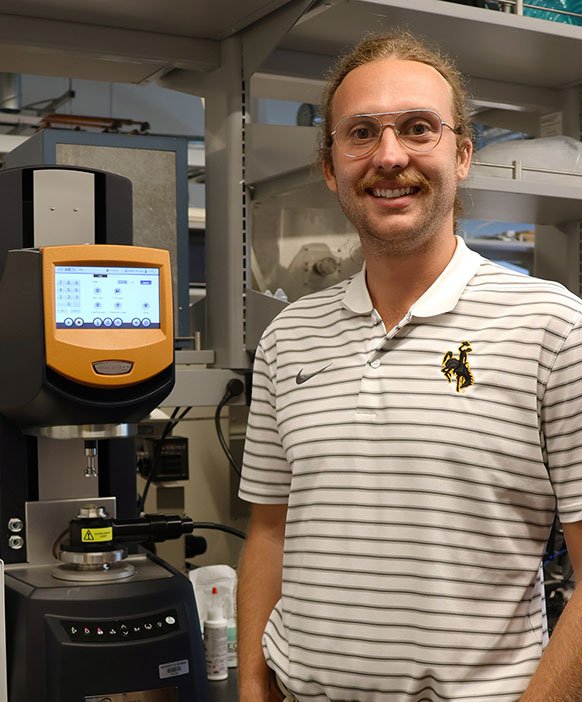
Daniel Rau, an assistant professor in UW’s Department of Mechanical Engineering. Photo via UW.
Exploring Elastomers with Advanced Techniques
Rau, who joined UW’s Department of Mechanical Engineering in fall 2024, will use his $198,932 award to study why current AM processes produce warped or unstable results when printing elastomers. His project, “Improving the Vat Photopolymerization 3D Printing of Soft Elastomers Through a Deeper Understanding of Process Dynamics,” aims to address this gap.
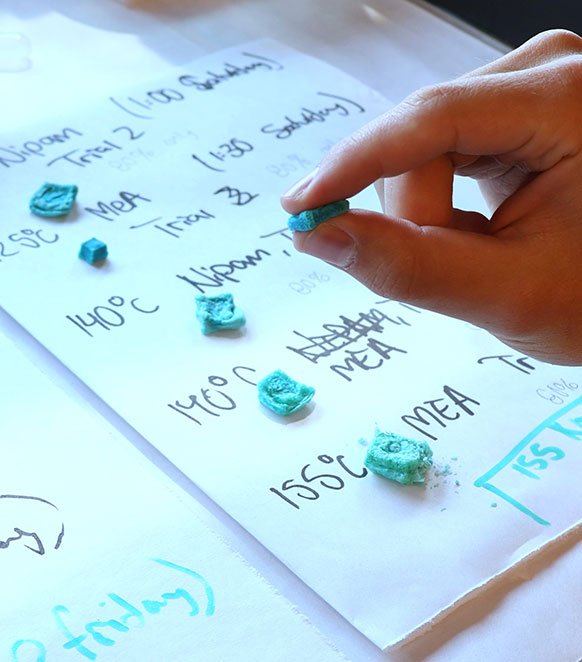
“This particular additive manufacturing process deals with a really unique class of materials called photopolymers. They’re liquid; you hit them with UV light—think of really strong sunlight—and they solidify,” Rau explains. “But we have a lot of questions on how that exact transition from liquid to solid occurs. Our materials are very soft, and we think there are some unique things going on, so we’re making measurements to look at that.”
To gain a deeper understanding of the printing process, Rau will employ two techniques—photorheology and X-ray photon correlation spectroscopy (XPCS)—to closely examine how photopolymers adhere and cure. For the XPCS experiments, he is collaborating with a team at Brookhaven National Laboratory in Long Island, N.Y., using their 2.5-kilometer synchrotron to focus X-ray beams on printed samples and capture highly localized insights into the curing dynamics.
The knowledge gained from these studies will allow Rau to develop a “cookbook” of methods to optimize AM processes for soft, flexible materials.
Efforts in Printing Soft Materials
Rau’s work builds on broader advances in soft-material 3D printing.In July, researchers at The University of Texas at Austin (UT Austin) developed a 3D printing method that replicates nature’s integration of soft and hard materials—such as the bone cushioned by cartilage. By using different colors of light to switch between flexible and rigid properties, the method allows for the fabrication of multi-material objects in a single print. The approach is expected to advance a wide range of applications, including prosthetics, medical devices, stretchable electronics, and soft robotics.
Earlier, in 2020, researchers at the National Institute of Standards and Technology (NIST) developed a new method of 3D printing gels and soft materials. Instead of using an ultraviolet laser (UV) or visible light to initiate their gel like most modern soft material 3D printers, the research team leveraged electron and X-ray beams to cure a range of photoresins. These shorter-wavelength lasers proved to be more focused than conventional beams, and enabled the fabrication of gels with a high level of structural detail, at sizes as small as 100 nanometers (nm).
*This article originally appeared on 3D Printing Industry. Paloma Dura is the original author of this piece.