TOwCmtFIEL(1)

RESEARCHERS DEVELOP 3D PRINTED HIGH-ENTROPY SUPERALLOY

Researchers at the IMDEA Materials Institute, a Madrid-based research center focused on advanced materials and manufacturing technologies, have developed a cobalt- and nickel-based high-entropy superalloy (CoNi-HESA) optimized for additive manufacturing through Laser Powder Bed Fusion (LPBF). Published on November 18, 2025, in Materials & Design, the study outlines a new route for producing jet engine components capable of operating at higher temperatures, improving both fuel efficiency and thrust.

The paper, Laser powder bed fusion of a novel CoNi-based high-entropy superalloy, details how LPBF was used to control the solidification process and grain uniformity during printing. By carefully adjusting laser power, scan speed, and layer thickness, the researchers reduced cracking and achieved dense, homogenous parts. This level of control over thermal gradients and cooling rates directly influences the alloy’s strength, ductility, and resistance to deformation under extreme conditions.

“The aerospace sector has long recognised the critical importance of increasing the maximum operating temperature of aircraft engines to enhance engine efficiency,” said Prof. José Manuel Torralba, Senior Researcher at IMDEA Materials and co-author of the paper. “As such, significant efforts have been devoted to the development of advanced metallic and intermetallic materials with exceptional performance capabilities.”

Ni-based superalloys have dominated aerospace manufacturing for decades due to their high-temperature strength and creep resistance. Cobalt-based alloys, meanwhile, offer superior oxidation and corrosion protection but have traditionally shown weaker mechanical performance at elevated temperatures. The CoNi-HESA alloy combines both material families, achieving a balance between strength, ductility, and thermal stability. Co-authors of the study include Prof. Torralba, former IMDEA Materials researchers Dr. Ahad Mohammadzadeh and Alessandro De Nardi, and Dr. Amir Mostafaei from the Illinois Institute of Technology.

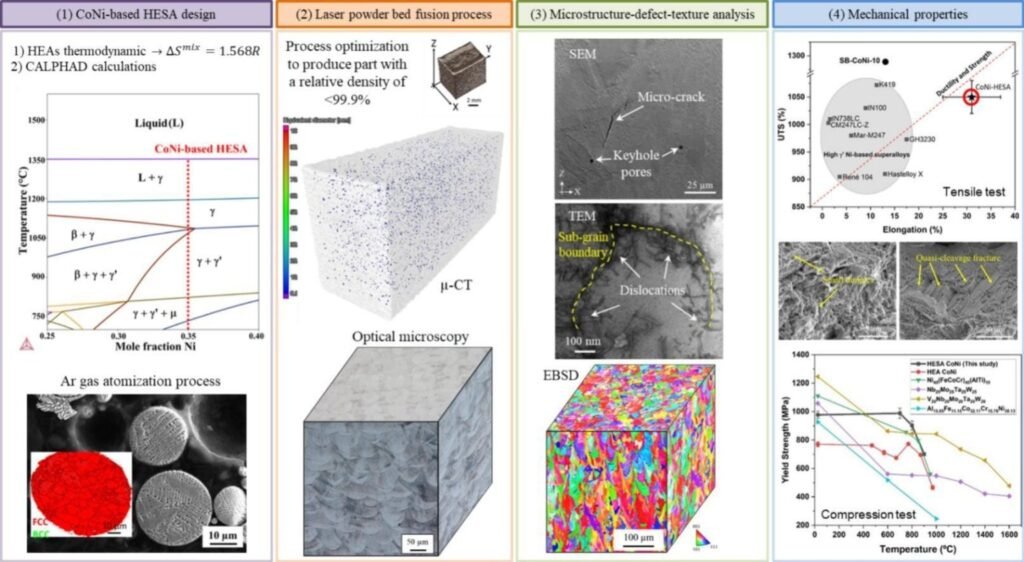
Graphical abstract. Image via Materials & Design.

“With a careful combination of laser power and scan speed in the LPBF process, the developed CoNi-HESA is well-suited for crack-resistant, high-density component production,” said Prof. Torralba. The researchers confirmed that thermodynamic predictions based on mixing entropy effectively guided alloy design, validating the concept that entropy-driven formulations can improve high-temperature mechanical properties. “As a final conclusion, we can state that the hypothesis, namely, that the design of CoNi-based superalloys through thermodynamic predictions based on mixing entropy can substantially improve material properties, has been confirmed,” they wrote.

The development of CoNi-HESA demonstrates how entropy-based alloy engineering can extend the limits of additive manufacturing in high-stress applications. The institute findings point toward broader implementation of high-entropy alloys across aerospace, energy, space, and nuclear sectors, where durability under extreme conditions remains a core challenge. “This is very promising for future additive manufacturing applications in fields such as energy, space and nuclear technology,” the authors noted.

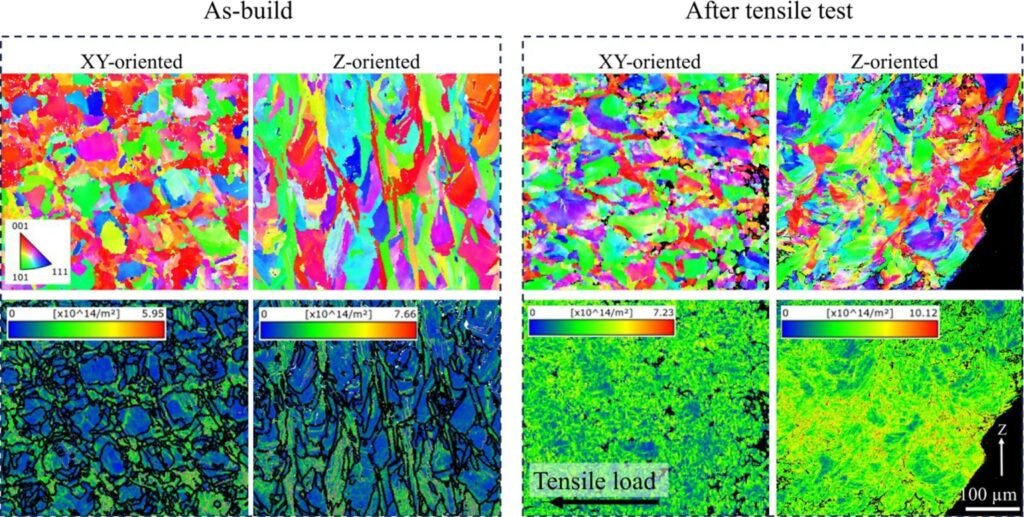
(top) IPF Z map and (bottom) GND maps taken from the fractured surface of sample No. 4 after tensile test. Image via Design & Light.

IMDEA Materials continues to investigate advanced alloys and microstructural design for metal additive manufacturing, aiming to expand industrial applications where temperature resistance and mechanical performance are critical. The CoNi-HESA results represent a step toward more efficient, longer-lasting components in next-generation jet engines and other thermally demanding systems. 

*This article originally appeared on [3DPrintingIndustry]. [ANYER TENORIO LARA] is the original author of this piece.

Have parts to make? Get free instant quote today.

Share the Post:

Related Posts

Knowledge Base
Stainless Steel 304: Comprehensive Analysis of Performance, Applications, and Selection Guide

Step into a modern kitchen, open a refrigerator, walk into an office building elevator, or observe medical equipment—in these seemingly different scenarios, one material silently underpins our lives: Stainless Steel 304. As the most common and widely used grade of austenitic stainless steel, SS304 has become an “invisible champion” in industrial manufacturing and daily life, thanks to its excellent corrosion resistance, good formability, and outstanding hygienic properties.
Since stainless steel was invented in the early 20th century, 304 stainless steel has evolved into the world’s most popular stainless steel variety, accounting for approximately 50% of the stainless steel market share. From aerospace to food processing, from architectural decoration to medical devices, this alloy occupies an irreplaceable position in modern materials science due to its unique combination of properties. This article will provide a comprehensive analysis of the chemical composition, mechanical properties, application fields, processing techniques, and selection guidelines for 304 stainless steel, offering a thorough reference for engineers, designers, purchasers, and general consumers.

Read More

Join our newsletter to stay updated

Scroll to Top