Bercella creates aerospace lamination mold using Xenia’s XECARB 40-C20-3DP

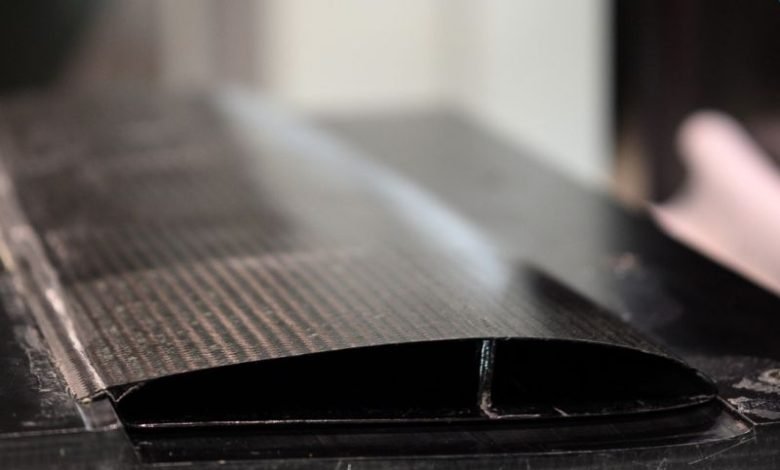
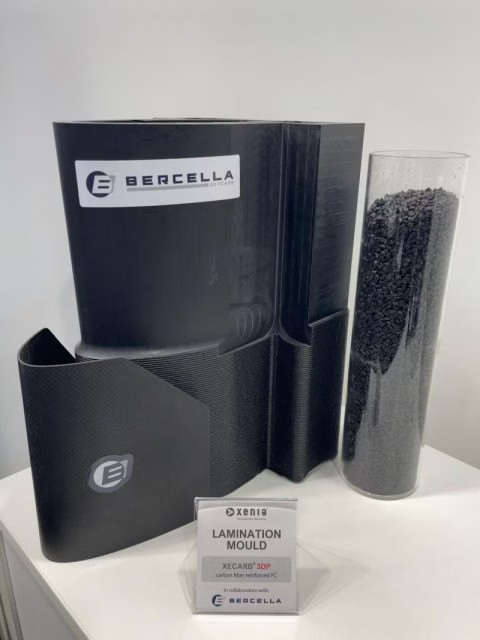
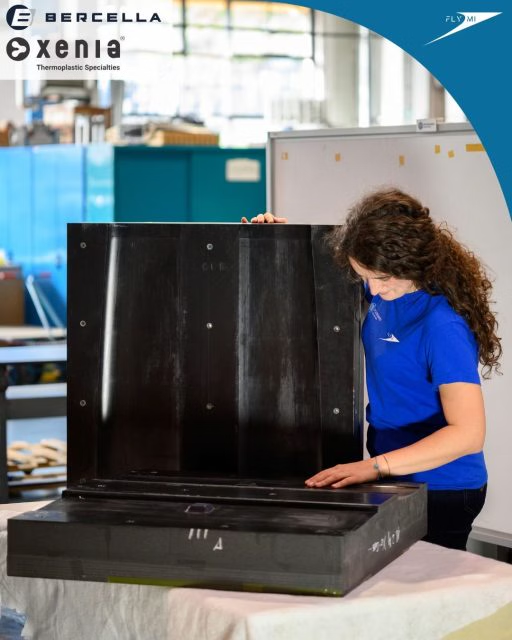
During Formnext 2025, Xenia Materials highlighted a collaboration with Italian composite engineering specialist Bercella S.p.A., which produced an aerospace lamination mold using XECARB® 40-C20-3DP, a polycarbonate reinforced with 20% carbon fiber. Fly Mi – EUROAVIA Milano, a student team participating in the IMechE Unmanned Aerial Systems (UAS) Challenge, used the mold to produce the wings of their aircraft.

The XECARB 40-C20-3DP material that Xenia provided to create the wing molds is a carbon-fiber-reinforced polycarbonate that can be fully recycled by shredding and reprocessing the thermoplastic granules after use. Bercella transformed these designs into reality through large-scale 3D printing combined with precision milling and its extensive expertise in composite fabrication.

According to the Fly Mi team, this collaboration was instrumental in producing the lightweight, high-performance wings that contributed to their success at the UAS Challenge.

With a service temperature of 140°C, XECARB 40-C20-3DP shows that polymer-based additive manufacturing materials can meet the demanding conditions of aerospace tooling. The mold produced by Bercella serves as a case study in how lightweight, fiber-reinforced polymers can replace traditional metal tooling, offering faster turnaround times and greater design flexibility without compromising precision or durability.

The collaboration between Bercella and Xenia demonstrates the compatibility of high-performance composite materials and additive manufacturing for aerospace-grade production. By using XECARB 40-C20-3DP in a functional lamination mould, the project underlines how precision engineering and advanced materials can accelerate innovation in composite tooling.

Founded more than 25 years ago, Bercella specializes in the design and production of composite components for aerospace, defense, motorsport, and industrial applications. The company operates across multiple advanced manufacturing processes, including autoclave molding, filament winding, and compression molding, as well as CNC machining, painting, and structural bonding.

Since 2013, Bercella has expanded its capabilities from component industrialization and tooling design to full structural design, allowing it to support customers from the earliest specification stages. Its vertically integrated model enables design, manufacturing, and qualification under one roof, significantly shortening project timelines and reducing costs.

The company’s investment in a materials testing and qualification laboratory in 2018 further strengthened this integrated approach, positioning Bercella among the few European firms capable of managing the entire product lifecycle — from material validation to final part production — internally.

*This article originally appeared on VoxelMatters. Davide Sher is the original author of this piece.

Have parts to make? Get free instant quote today.

Share the Post:

Related Posts

Knowledge Base
17-4 Stainless Steel Comprehensive Guide: In-depth Analysis of Performance, Applications, and Processing Technology

In today’s industrial manufacturing sector, the selection of materials directly determines the performance, lifespan, and cost-effectiveness of the final product. Among numerous high-performance metal materials, 17-4 Stainless Steel (also known as 17-4 PH) has become one of the preferred materials for the aerospace, medical device, petrochemical, and high-end mechanical manufacturing industries due to its unique precipitation hardening characteristics. As a martensitic precipitation hardening stainless steel, 17-4 not only possesses the inherent corrosion resistance of stainless steel but also achieves extremely high strength and hardness through heat treatment. This dual advantage allows it to maintain excellent stability even in extreme environments.

Read More
Knowledge Base
A Comprehensive Guide to Nickel Plating in CNC Machining

In the chain of high-end manufacturing, CNC (Computer Numerical Control) machining is responsible for giving parts their geometric shapes and dimensional accuracy, while surface treatment determines the lifespan, functionality and reliability of the parts. Among various surface treatment processes, nickel plating has become one of the most commonly used post-processing techniques for CNC machined components due to its unique comprehensive properties – combining corrosion resistance, wear resistance, lubricity and excellent appearance.

Whether it is the precision valve bodies in the aerospace field, the aluminum alloy casings in consumer electronics, or the transmission components in the automotive industry, nickel plating plays an indispensable role.

Read More

Join our newsletter to stay updated

Scroll to Top