🚀 July 11 Update – Batch Edit, Re-Quote, Tiered Pricing & Notifications Are Here
Dear Valued Customer,
We've just released another major update with improvements across the Instant Quote, Cart, Checkout, Dashboard, and Order Management.
As we're continuously shipping new features, there may still be occasional bugs or unexpected issues. If you find anything that doesn't work as expected, please let us know—we truly appreciate your feedback and will fix it as quickly as possible.
🛠 Instant Quote
🏷 Material Tags added to help you choose the most suitable material. 📊 Tiered Pricing is now available. Instantly compare quantity discounts and select the best pricing option. ✏️ Batch Edit for multiple parts. Update configurations or delete multiple parts at once.
🛒 Cart
🔄 Re-Quote any part directly from your cart and continue editing before placing your order. 🛍 Mini Cart added to the header, allowing you to quickly view your cart from any page.
📦 Orders
♻️ Add to Quote and Add All to Quote are now available for existing orders. Reuse previous parts, make changes, and generate a new quote in just one click.
💳 Checkout
🌍 Customs & Shipping Options added.
Choose how you want customs declaration handled. Set your preferred Customs Value. Tell us your Expected Shipping Date.
🔔 Dashboard
🔔 Notifications keep you updated on order status and important activities. 📢 Announcements provide the latest ProtoTi news and product updates.
⚡ Performance & Improvements
We've also fixed and optimized numerous issues across:
Instant Quote
Checkout
Order Details
making the overall experience smoother and more reliable.
💬 Found a bug or have a feature request?
We're releasing new features rapidly, and your feedback helps us improve faster.
Metal additive manufacturing, especially Selective Laser Melting (SLM), has transformed modern manufacturing by enabling complex geometries, lightweight structures, and highly integrated parts. Industries such as aerospace, automotive, and medical devices increasingly rely on metal 3D printing for both prototyping and production.
However, like any advanced manufacturing process, metal 3D printing can experience various printing defects if parts are not properly designed or if process parameters are not optimized.
Understanding these common defects and how to prevent them is essential for achieving high-quality printed metal parts.
Warping and Deformation
Warping is one of the most common issues in metal 3D printing. During the printing process, metal powder is melted by a high-energy laser and then rapidly cooled. This heating and cooling cycle creates thermal stress inside the part.
When internal stress becomes too large, the part may:
Proper design for additive manufacturing (DfAM) can significantly reduce deformation during printing.
Porosity (Internal Voids)
Porosity refers to tiny holes or voids inside the printed metal part. These internal defects can reduce mechanical strength and compromise the reliability of the component.
Porosity is particularly critical in industries that require high structural integrity, such as aerospace and medical implants.
Advanced process control systems are often used to monitor and improve melt pool stability.
Rough Surface Finish
Compared with traditional machining, metal 3D printed parts often have a rougher surface finish, especially on downward-facing surfaces or areas with overhangs.
This occurs because partially melted powder particles may adhere to the surface during the printing process.
Support structures are essential for stabilizing parts during metal 3D printing. However, after supports are removed, they often leave visible marks on the surface.
These marks may affect both aesthetics and dimensional accuracy.
How to Reduce Support Marks
Designers can minimize these marks by:
Placing supports on non-critical surfaces
Optimizing build orientation
Reducing unnecessary supports
Applying post-processing finishing
Careful design planning can significantly reduce the impact of support removal.
Balling Effect
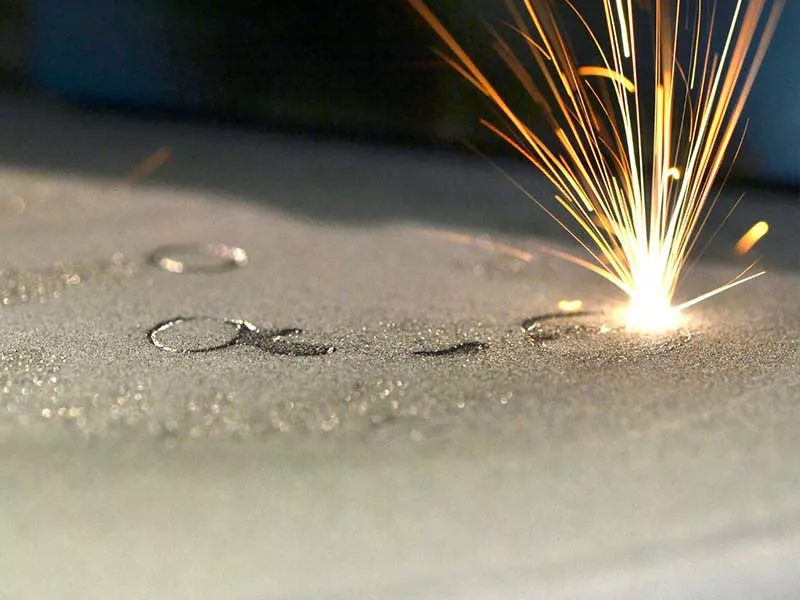
The balling effect occurs when molten metal forms small spherical droplets instead of smooth melt tracks. This can lead to poor bonding between layers and an unstable printing process.