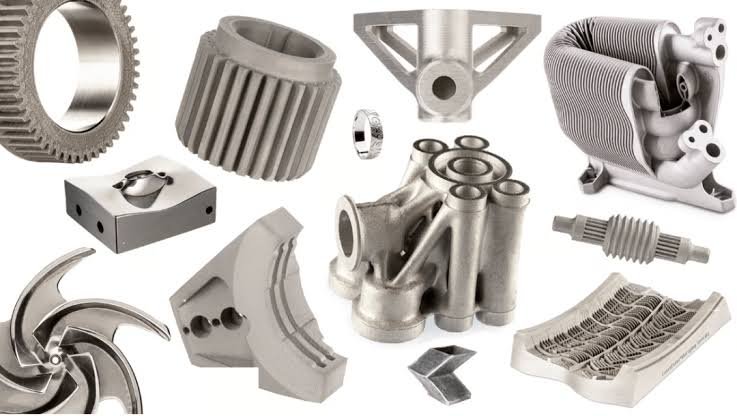
Binder Jetting (BJ) is a rapidly growing additive manufacturing technology that is widely used for producing metal, sand, and ceramic parts. Unlike laser-based processes such as SLM, Binder Jetting does not use high-energy lasers to melt material. Instead, it uses a liquid binding agent to join powder particles together.
How Binder Jetting Works
The Binder Jetting process is based on selectively depositing a liquid binder onto a powder bed. The process typically involves the following steps:
Powder Spreading
A thin layer of metal or ceramic powder is spread evenly across the build platform
Binder Deposition
An industrial print head selectively deposits a liquid binder onto the powder, bonding particles together according to the part geometry.
Layer-by-Layer Printing
The process repeats layer by layer until the full part is formed, similar to other 3D printing technologies.
Curing and Depowdering
Once printing is complete, the “green part” is cured and removed from the powder bed.
Sintering
The part is then sintered in a furnace, where the binder is burned off and the metal particles fuse together, resulting in a dense solid component.
Advantages of Binder Jetting
Binder Jetting offers several key benefits:
- No support structures required
- High production speed
- Lower cost compared to laser-based metal printing
- Suitable for complex geometries
Because the surrounding powder supports the part, design freedom is significantly increased.Because the surrounding powder supports the part, design freedom is significantly increased.
Conclusion
Say goodbye to supports, enjoy design freedom, and achieve low-cost mass production – that’s the core appeal of BJ technology.
If your parts are complex, need to be made in large quantities, and you want to avoid the hassle of support removal, BJ is an excellent choice.