🏮 Holiday Notice – Mid-Autumn Festival & National Day
Dear Valued Customer,
As China's Mid-Autumn Festival (September 25–27) and National Day Holiday (October 1–7) are approaching, our production and logistics operations will be affected during this period. 🏮✨
📦 Orders Placed by September 30
😊 Priority Handling Orders placed on or before September 30 will be given priority.
🚚 Production & Shipping Arrangement We will do our best to arrange production before the holiday and ship your orders as soon as possible after the holiday.
⏰ Orders Placed During October 1–7
🕒 Additional Lead Time Orders placed between October 1 and October 7 may experience an additional lead time of approximately 8–10 days due to the holiday schedule.
🚀 Planning an Upcoming Project?
📅 Order in Advance If you have an upcoming project, deadline, or time-sensitive order, we recommend placing your order in advance to help avoid potential delays.
💛 Thank You for Your Understanding
Thank you very much for your understanding, patience, and continued support. We truly appreciate your trust in us and will continue doing our best to provide you with reliable service.
🌕Wishing you all a smooth and successful work schedule, and good health and happiness to you and your family!
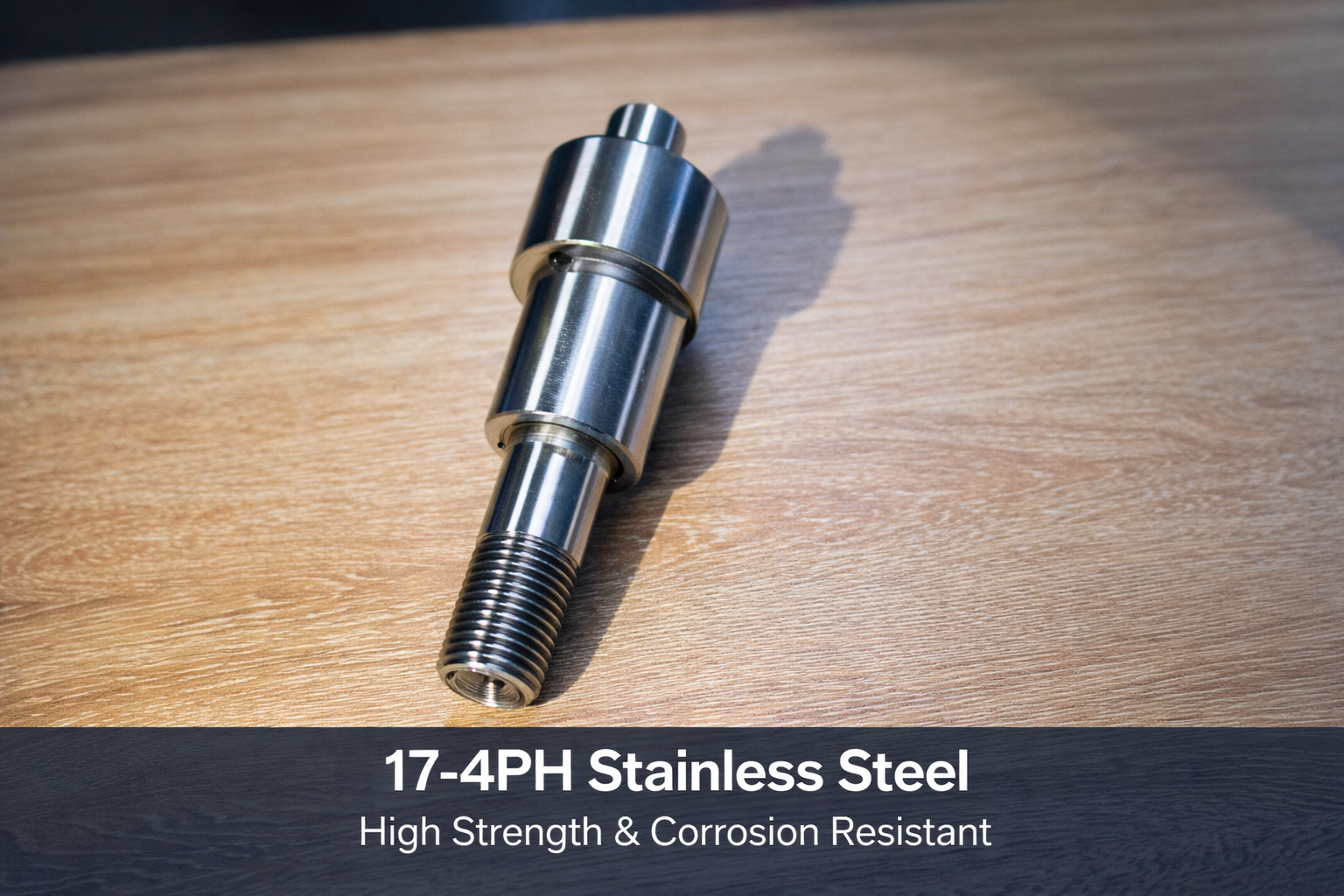
In today's industrial manufacturing sector, the selection of materials directly determines the performance, lifespan, and cost-effectiveness of the final product. Among numerous high-performance metal materials, 17-4 Stainless Steel (also known as 17-4 PH) has become one of the preferred materials for the aerospace, medical device, petrochemical, and high-end mechanical manufacturing industries due to its unique precipitation hardening characteristics. As a martensitic precipitation hardening stainless steel, 17-4 not only possesses the inherent corrosion resistance of stainless steel but also achieves extremely high strength and hardness through heat treatment. This dual advantage allows it to maintain excellent stability even in extreme environments.
🌟Content in this article
What is 17-4 Precipitation Hardening Stainless Steel?
17-4PH stainless steel is a typical precipitation-hardening martensitic stainless steel that plays a crucial role in modern industrial materials. Compared with traditional austenitic stainless steels such as 304 and 316, as well as conventional martensitic stainless steels, 17-4PH not only offers good corrosion resistance but can also significantly improve its strength and hardness through heat treatment, making it ideal for critical components requiring high reliability.
In terms of naming, “17” in 17-4PH represents approximately 17% chromium content, while “4” stands for about 4% nickel. “PH” refers to precipitation hardening, which is the key mechanism used to enhance its mechanical properties. This naming convention clearly reflects both its composition and strengthening principle.
After solution treatment, 17-4PH stainless steel exhibits a martensitic structure. During aging, copper-rich precipitates form, significantly increasing the material’s strength. This microstructural control mechanism makes it a representative high-performance engineering material.
Chemical composition and action mechanism of 17-4PH stainless steel
The chemical composition of 17-4PH stainless steel is carefully engineered to balance strength, corrosion resistance, and machinability. Its main elements include chromium (Cr), nickel (Ni), copper (Cu), niobium (Nb) or tantalum (Ta), along with small amounts of carbon (C), manganese (Mn), and silicon (Si).
Understanding the performance of 17-4 Stainless Steel must start with its chemical composition. The addition of each alloying element is not arbitrary but is intended to achieve specific metallurgical purposes. According to the ASTM A564 standard, the main chemical components of 17-4 Stainless Steel include Iron (Fe), Chromium (Cr), Nickel (Ni), Copper (Cu), and small amounts of Niobium (Nb) and Carbon (C). The proportions of these elements are strictly controlled to ensure the material achieves expected performance indicators after heat treatment.
Chromium (Cr) is the alloying element with the highest content in 17-4 Stainless Steel, typically ranging between 15.0% and 17.5%. The main role of chromium is to form a dense chromium oxide passivation film on the surface of the steel, which is the foundation of the material’s corrosion resistance. Without sufficient chromium, the material would be unable to resist erosion from the atmosphere, water, or chemical media. In 17-4, the chromium content is sufficient to provide corrosion resistance superior to ordinary carbon steel, although slightly lower than 304 Stainless Steel, it is enough to meet the needs of most industrial environments.
The content of Nickel (Ni) is typically between 3.0% and 5.0%. The role of nickel in 17-4 is multifaceted. First, it helps stabilize the martensitic structure, ensuring that the material forms the required microstructure after quenching. Second, nickel improves the toughness and ductility of the material, preventing it from becoming too brittle when reaching high hardness. Additionally, nickel works synergistically with copper, participating in the precipitation hardening reaction, which is crucial for the final strength improvement.
Copper (Cu) is the key element of the 17-4 precipitation hardening mechanism, with content typically between 3.0% and 5.0%. During the aging process, copper precipitates from the supersaturated solid solution in the form of metallic copper, forming fine precipitate phases. These precipitate phases pin within the lattice like nails, greatly hindering dislocation slip, thereby significantly improving the material’s yield strength and tensile strength. Without copper, 17-4 would not be able to achieve its signature high-strength characteristics.
The total content of Niobium (Nb) and Tantalum (Ta) is typically between 0.15% and 0.45%. The main role of these elements is to form carbides, thereby fixing the carbon element and preventing carbon from combining with chromium to form chromium carbides. If carbon combines with chromium, it leads to a reduction in chromium content near the grain boundaries, thereby triggering intergranular corrosion. Therefore, the addition of niobium not only refines the grains but also indirectly protects the material’s corrosion resistance, especially in the weld heat-affected zone.
The content of Carbon (C) is strictly controlled below 0.07%. Low carbon content is crucial for ensuring the weldability and corrosion resistance of 17-4. Excessive carbon content increases the brittleness of the material and reduces its corrosion resistance. By limiting carbon content, 17-4 can possess relatively good machinability and weldability while maintaining high strength, which gives it a wider range of applications compared to traditional high-carbon martensitic stainless steels (such as 440C).
Detailed Explanation of Heat Treatment Process for 17-4 Stainless Steel
Basic Principles of Heat Treatment Processes
The most significant technical characteristic of 17-4PH stainless steel lies in its ability to achieve significant performance enhancement and flexible control through heat treatment. This heat treatment response characteristic distinguishes 17-4PH from traditional austenitic and martensitic stainless steels, making it a highly engineered precipitation-hardening material. Understanding its heat treatment principles is a prerequisite for the correct application of this material.
The heat treatment process for 17-4PH is typically divided into two main stages: solution treatment and aging treatment, sometimes also referred to as precipitation hardening treatment. These two stages have distinct physical metallurgy significance and together determine the material’s final microstructure and mechanical properties.
The core purpose of solution treatment is to uniformly dissolve alloying elements into the matrix, forming a uniform supersaturated solid solution. In this process, the material is heated to a sufficiently high temperature, typically 1020°C to 1060°C, allowing copper, niobium, and other alloying elements as well as carbides to fully dissolve into the austenite matrix. After sufficient holding time, the material is rapidly cooled, usually by oil quenching or air cooling, causing the high-temperature austenite to transform into martensite. This rapid cooling suppresses the precipitation of alloying elements during cooling, thereby forming a supersaturated martensitic solid solution, a condition known as “Condition A” or “solution-treated condition.”
Aging treatment is the key step for 17-4PH to achieve high strength. Based on solution treatment, the material is reheated to a specific temperature range, typically 480°C to 620°C, and held for a certain period. During this process, copper atoms in the supersaturated solid solution diffuse and aggregate, forming nanoscale copper-rich precipitates (ε-Cu phases). Meanwhile, niobium atoms also combine with carbon atoms to form niobium carbide precipitates. These finely dispersed precipitates effectively hinder dislocation movement, thereby significantly improving the material’s yield strength and tensile strength.
Aging temperature has a decisive influence on the kinetics of the precipitation process and the size distribution of precipitates. Lower aging temperatures (such as 480°C) yield finer and denser precipitates, resulting in stronger strengthening effects; however, material plasticity and toughness decrease simultaneously. Higher aging temperatures (such as 620°C) lead to precipitate coarsening, weakening the strengthening effect, but material toughness and resistance to stress corrosion cracking improve. It is precisely this correspondence between aging temperature and properties that enables 17-4PH to meet the requirements of different service conditions by selecting different aging temperatures.
Solution Treatment Process Specifications
Solution treatment is the foundational step in 17-4PH heat treatment, and the selection of its process parameters directly affects the effectiveness of subsequent aging treatment and the material’s final performance.
The heating temperature for solution treatment is typically controlled between 1020°C and 1060°C. The selection of this temperature range is based on the following considerations: first, this temperature is higher than the dissolution temperature of alloying elements such as copper and niobium in austenite, ensuring full dissolution of these elements; second, this temperature range lies within the austenite single-phase region, allowing for uniform austenitic structure; additionally, this temperature is below the material’s grain coarsening temperature, preventing excessive grain growth and thus maintaining good toughness.
Holding time depends on the size and thickness of the material. For workpieces of typical dimensions, holding time is usually 30 to 60 minutes per 25 millimeters of thickness. Insufficient holding time leads to incomplete dissolution of alloying elements, affecting the subsequent aging strengthening effect; excessive holding time may cause grain coarsening, reducing material toughness.
Cooling method has an important influence on the effectiveness of solution treatment. For most 17-4PH materials, oil quenching or air cooling are acceptable cooling methods. The purpose of rapid cooling is to suppress the precipitation of alloying elements during cooling and maintain the supersaturated solid solution state. For thinner materials, air cooling can achieve satisfactory cooling effects; for thicker materials, oil quenching may be required to ensure sufficient cooling rate.
After solution treatment, 17-4PH is in Condition A, with the microstructure primarily consisting of martensite and a small amount of retained austenite. In this condition, material hardness typically does not exceed 38 HRC, exhibiting good machinability suitable for various machining and forming operations. Therefore, in actual production, the material is typically solution-treated first, then machined, and finally aged to achieve the required final properties.
Aging Treatment Process Specifications
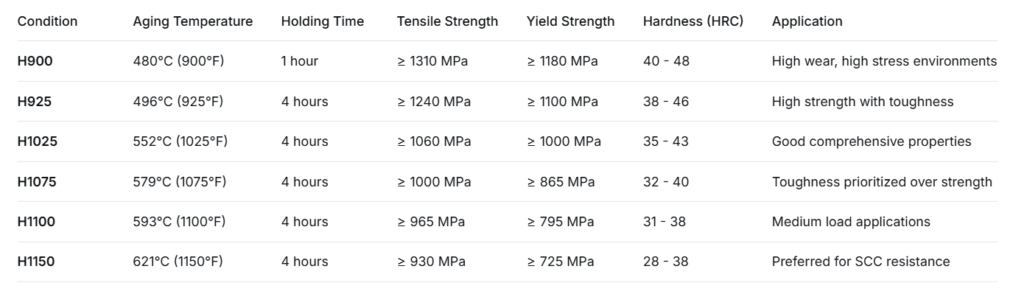
Aging treatment is the key step for 17-4PH to achieve high strength. By selecting different aging temperatures, different performance grades can be obtained. These performance grades are typically designated by “H” followed by the aging temperature in degrees Fahrenheit, such as H900, H1025, H1100, H1150, etc.
The H900 condition is the most commonly used high-strength condition, with aging process involving heating to 480°C and holding for 1 hour. In this condition, the material achieves the highest strength and hardness, with tensile strength reaching above 1310 MPa, yield strength above 1180 MPa, and hardness ranging from 40 to 48 HRC. The H900 condition is suitable for applications with extremely high requirements for wear resistance and strength, such as shaft components under high stress, fasteners, valve components, etc. However, it is important to note that the H900 condition has relatively lower impact toughness and relatively poorer resistance to stress corrosion cracking, requiring caution when used in environments where stress corrosion cracking may occur.
The H925 condition involves aging at 496°C with a holding time of 4 hours. Compared to H900, the H925 condition has slightly lower strength but improved toughness and stress corrosion resistance. This condition finds application in situations requiring higher comprehensive performance.
The H1025 condition is another commonly used aging condition, with aging process involving heating to 552°C and holding for 4 hours. In this condition, the material achieves tensile strength of approximately 1060 MPa, yield strength of approximately 1000 MPa, and hardness ranging from 35 to 43 HRC. The H1025 condition exhibits significantly better impact toughness than H900, while also providing good resistance to stress corrosion cracking. This condition is suitable for applications requiring both relatively high strength and certain levels of toughness and corrosion resistance.
The H1075 condition involves aging at 579°C with a holding time of 4 hours. In this condition, strength reaches approximately 1000 MPa, yield strength approximately 865 MPa, and hardness ranging from 32 to 40 HRC. The H1075 condition further improves toughness and corrosion resistance while maintaining relatively high strength.
The H1100 condition involves aging at 593°C with a holding time of 4 hours. This condition achieves tensile strength of approximately 965 MPa, yield strength of approximately 795 MPa, and hardness ranging from 31 to 38 HRC. The H1100 condition strikes a good balance between strength and toughness, suitable for medium-load applications.
The H1150 condition involves aging at 621°C with a holding time of 4 hours. This condition provides the best combination of toughness and resistance to stress corrosion cracking while maintaining relatively high strength. The H1150 condition is typically used in environments with stress corrosion cracking risks, such as marine engineering and chemical processing.
Aging Treatment Process
Mechanical and Physical Properties
Diversity of Mechanical Properties
The mechanical properties of 17-4PH vary significantly with heat treatment condition, and this adjustability of properties is one of its greatest engineering advantages. By selecting different aging treatment conditions, the material’s tensile strength can vary within the range of 930 MPa to 1310 MPa, yield strength between 725 MPa and 1180 MPa, and hardness between 28 HRC and 48 HRC.
In addition to strength and hardness, plasticity indicators such as elongation and reduction in area also vary with heat treatment condition. In the H900 condition, elongation is typically around 10%, exhibiting high strength with low plasticity characteristics; in the H1150 condition, elongation can reach above 16%, demonstrating better plasticity. This trade-off between strength and plasticity is a key factor to consider in material design.
Impact toughness is an important indicator for evaluating a material’s ability to resist dynamic loading. The impact toughness of 17-4PH is also significantly influenced by aging temperature. As aging temperature increases, the material’s impact toughness gradually improves. The impact toughness of the H1150 condition is significantly better than that of the H900 condition, making H1150 more suitable for applications subjected to impact loads.
Physical Property Parameters
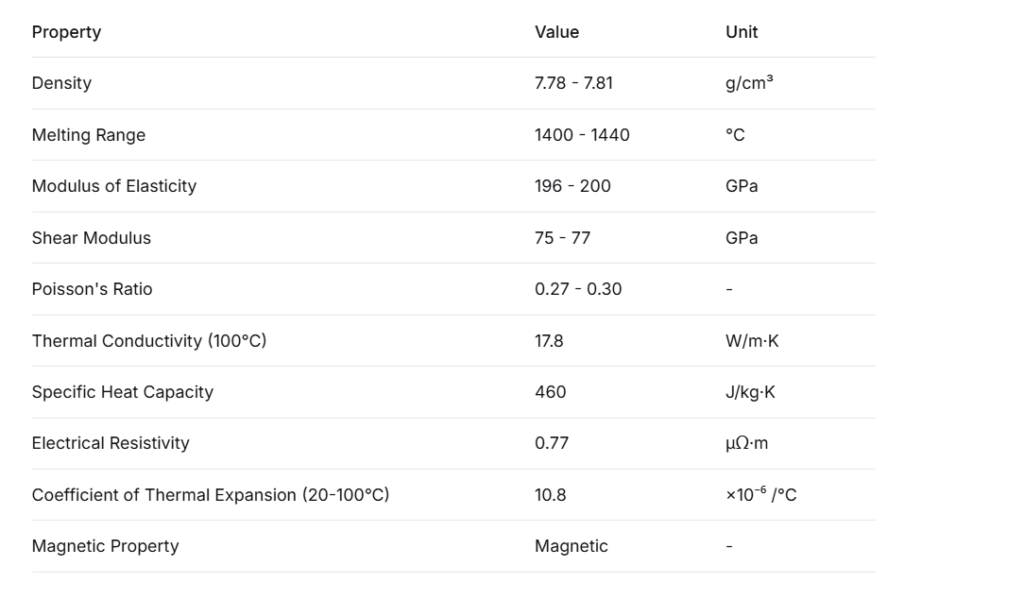
Understanding the physical properties of 17-4PH is crucial for design engineers, as these parameters directly affect the thermal conduction, thermal expansion, magnetic behavior, and other aspects of components during service.
Density is one of the fundamental physical parameters of materials. The density of 17-4PH is approximately 7.78 to 7.81 g/cm³, slightly lower than that of pure iron and similar to that of most stainless steels. This density value gives 17-4PH certain advantages in applications requiring lightweight design.
Elastic modulus reflects a material’s ability to resist elastic deformation. The elastic modulus of 17-4PH is approximately 196 to 200 GPa, comparable to carbon steel. This means that under the same load, the elastic deformation of 17-4PH components is similar to that of carbon steel components.
Thermal conductivity affects a material’s ability to conduct heat. The thermal conductivity of 17-4PH at 100°C is approximately 17.8 W/m·K, much lower than carbon steel but higher than austenitic stainless steels. This means 17-4PH has a moderate level of thermal conductivity.
Specific heat capacity is an indicator of a material’s ability to store heat. The specific heat capacity of 17-4PH is approximately 460 J/kg·K, comparable to most metallic materials.
Electrical resistivity affects a material’s electrical conductivity. The electrical resistivity of 17-4PH is approximately 0.77 µΩ·m, placing it among metallic materials with relatively poor electrical conductivity. This characteristic needs to be considered in certain electrical applications.
Magnetism is an important characteristic of 17-4PH. As a martensitic stainless steel, 17-4PH is magnetic, which contrasts sharply with the non-magnetic nature of austenitic stainless steels. This characteristic may be advantageous in certain applications (such as solenoid valves), while requiring special attention in other applications.
Physical Properties
The corrosion resistance mechanism of 17-4PH stainless steel
The corrosion resistance of 17-4PH stainless steel mainly comes from its high chromium content. When chromium exceeds about 12%, a dense and stable chromium oxide passive film forms on the surface, effectively preventing further oxidation.
However, compared to austenitic stainless steels like 316, 17-4PH has slightly lower resistance in chloride-rich environments. Its martensitic structure is more susceptible to pitting and stress corrosion cracking, requiring additional precautions in marine conditions.
In practice, surface treatments such as polishing, plating, or passivation can further enhance corrosion resistance by improving surface density and durability.
The processing properties of 17-4PH stainless steel
17-4PH stainless steel has good machinability and can be processed through turning, milling, and drilling. However, due to its high strength, high-hardness tools and optimized cutting parameters are required.
In the solution-treated condition, the material is softer and easier to machine, so many manufacturers perform machining before aging.
It also offers acceptable weldability, but post-weld heat treatment is necessary to relieve stress and restore mechanical properties.
Key Application Areas
Aerospace Industry
The aerospace industry has extremely stringent requirements for materials, demanding both high strength to reduce structural weight and good corrosion resistance to withstand complex service environments. 17-4PH stainless steel has gained widespread application in the aerospace field due to its excellent comprehensive properties.
In aircraft engines, 17-4PH is used to manufacture critical rotating components such as turbine engine blades, compressor blades, and turbine disks. These components operate under high temperature and high stress conditions, requiring extremely high strength and fatigue resistance. The high strength achieved through H900 heat treatment enables 17-4PH to meet these demanding requirements.
In aircraft structural components, 17-4PH is used to manufacture critical load-bearing structures such as landing gear components, engine pylons, and wing attachment fittings. These components have high requirements for strength, toughness, and fatigue performance, and 17-4PH in the H1025 or H1150 condition can provide good comprehensive properties.
Petrochemical and Chemical Industry
The petrochemical industry involves large quantities of corrosive media and high-pressure conditions, placing high demands on materials for both corrosion resistance and strength. 17-4PH stainless steel plays an important role in this field.
Valves and valve stems are critical control components in chemical plants. Leveraging its high strength, good corrosion resistance, and wear resistance, 17-4PH is widely used to manufacture various types of valve stems, valve seats, balls, and other components. Particularly under demanding conditions involving high pressure, high temperature, and corrosive media simultaneously, 17-4PH demonstrates excellent reliability.
Pump shafts and impellers are important components for conveying corrosive media. The high strength and good corrosion resistance of 17-4PH make it an ideal material for manufacturing chemical pump shafts and impellers. By selecting the appropriate aging condition (such as H1150), good resistance to stress corrosion cracking can be achieved while maintaining strength.
Food Processing Industry
The food processing industry has strict requirements for material hygiene and corrosion resistance, while equipment needs to withstand frequent cleaning and sanitization processes. 17-4PH stainless steel finds application in the food processing field due to its good corrosion resistance and easy-to-clean characteristics.
Components of food processing equipment such as mixers, agitators, and conveying screws come into contact with various food ingredients during processing, requiring materials with good corrosion resistance and no adverse reactions with food. 17-4PH meets these requirements, and its high strength characteristics also enable equipment to withstand significant mechanical loads.
Dairy equipment has even higher requirements for surface quality and corrosion resistance. 17-4PH is used to manufacture key components in dairy processing equipment, such as homogenizer valve seats, pump bodies, and piping. Its good corrosion resistance ensures long-term stable operation of equipment and the hygienic safety of products.
17-4PH Stainless Steel Compared with Other Materials
Compared to 304, 17-4PH has much higher strength but slightly lower corrosion resistance. 304 suits general use, while 17-4PH is for high-strength applications.
Compared to 316, it is less resistant to chlorides but significantly stronger, making it better for structural components.
Compared to alloy steels, it offers better corrosion resistance and longer service life in harsh environments.
The future development trend of 17-4PH stainless steel
As manufacturing advances, demand for high-performance materials like 17-4PH continues to grow, especially in energy, aerospace, and medical sectors.
Future developments may enhance performance through composition optimization or process improvements.
Additive manufacturing is also expanding the use of 17-4PH powder as a new growth area.
Conclusion
17-4PH (UNS S17400 / Type 630) is a precipitation-hardening martensitic stainless steel of great engineering value, perfectly combining the good corrosion resistance of austenitic stainless steels with the high-strength characteristics of martensitic steels. Since its introduction in the mid-20th century, this material has gained widespread applications globally due to its unique combination of properties, becoming an indispensable key material in modern industry.
The most significant technical characteristic of 17-4PH lies in its ability to achieve flexible property adjustment through heat treatment. By selecting different aging temperatures, the material’s strength, hardness, toughness, and corrosion resistance can be adjusted over a wide range to meet the requirements of various complex service conditions. This property adjustability makes 17-4PH a highly engineered material, allowing designers to precisely select the most appropriate heat treatment condition based on the specific service conditions of components.
In terms of chemical composition, 17-4PH ensures excellent comprehensive properties through precise control of alloying elements including carbon, chromium, nickel, copper, and niobium. The low carbon design improves weldability and corrosion resistance, the moderate chromium content provides good passivation capability, the addition of copper enables precipitation hardening, and the inclusion of niobium refines grain size and improves weldability.
In conclusion, 17-4PH stainless steel is a high-performance material combining strength, corrosion resistance, and machinability, widely used in critical industries.
CNC machining on demand
Start your project today. Get free DFM from professional engineer at ProtoTi.