💰Spring Renewal & Women’s Day Promotion – 8% OFF Limited Time
🌸With the arrival of spring, our company has officially resumed full operation and production capacity after the Spring Festival holiday. We sincerely thank all customers for your patience and support.
To honor International Women’s Day and thank you for your trust, we are launching a limited-time special promotion:
⏰ Promotion Time March 5 – March 31
🎯 Exclusive Discount 8% OFF Coupon for all orders placed during the valid period.
💡 Warm Tips Place your order early to enjoy priority production and guaranteed delivery time.
This event is dedicated to celebrating the power of women worldwide and thanking you for your continued partnership.
For any inquiries, please contact our sales team.
Thank you for choosing us, and let’s move forward to a prosperous new year together!
esearchers at the California Institute of Technology (Caltech) have developed a technique that enables the precise creation of metallic structures with customized shapes and compositions. This technique offers scientists an unprecedented level of control over alloy design, making it possible to engineer materials with specific mechanical and functional properties. Potential applications range from biocompatible, high-strength stents to lightweight aerospace components capable of withstanding harsh environments for extended periods.
“If you look at how metallurgy has been done for centuries, in broad strokes, you nearly always start with a raw ore, which is then thermally and/or chemically treated and refined, to produce the desired metal or alloy. And basically, the mechanical properties of the metals produced this way are limited,” says Julia R. Greer, the Ruben F. and Donna Mettler Professor of Materials Science, Mechanics and Medical Engineering at Caltech. “What we are showing is that you can actually fine-tune the chemical composition and the microstructure of metallic materials, substantially enhancing their mechanical resilience.”
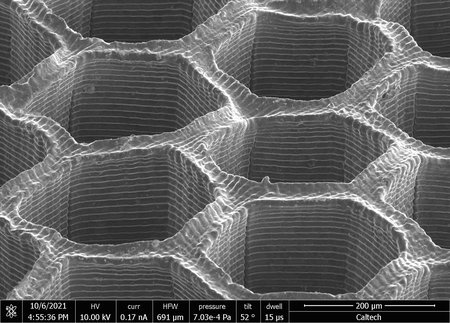
A honeycomb structure created with the new technique. Photo via Caltech.
Hydrogel-Infusion Additive Manufacturing (HIAM) and Dual-Metal Printing
The method, detailed in Small by lead author Thomas T. Tran (PhD ’25) and co-author Rebecca Gallivan (PhD ’23), builds on earlier work from Greer’s lab using hydrogel-infusion additive manufacturing (HIAM). Previously limited to single-metal prints, the HIAM process has now been adapted to incorporate multiple metals—successfully demonstrated through copper–nickel alloy fabrication.
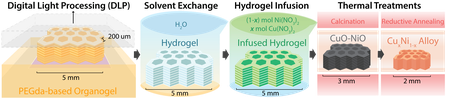
The process begins with 3D printing a hydrogel scaffold by depositing polymer resin layer by layer. This scaffold is infused with a solution of metallic salts and then subjected to calcination, removing organic material and forming metal oxides. In a final step—reductive annealing—the structure is heated in a hydrogen atmosphere, causing oxygen to exit the material and form water vapor, leaving behind a solid alloy in the intended shape and composition.
“The composition can be varied in whatever manner you like, which has not been possible in traditional metallurgy processes,” Greer explains. “One of our colleagues described this work as bringing metallurgy into the 21st century.”
Microstructural Insights and Enhanced Material Strength
The team used transmission electron microscopy (TEM) at the UC Irvine Materials Research Institute to analyze the internal structure of the alloys created through HIAM. Their findings revealed highly uniform crystal structures and a consistent distribution of grain orientation—factors influenced by the transformation from metal oxide to metal during reductive annealing.
As temperatures rise, water vapor escapes, forming pores that, along with remaining oxides, restrict grain growth. This study highlights that the specific types of oxides involved further influence how the grains develop within these 3D printed structures.
In addition, the findings reveal that alloy strength depends not only on grain size—as previously believed—but also on chemical composition. For instance, a Cu12Ni88 alloy, composed of 12% copper and 88% nickel, is nearly four times stronger than a Cu59Ni41 variant with a higher copper ratio.
The fabrication route for making copper-nickel alloys using the hydrogel influsion-based additive manufacturing (HIAM). Image via Caltech
Transmission electron microscopy (TEM) also uncovered nanoscale oxide inclusions formed during the HIAM process. These fine structures, rich in metal–oxide interfaces, strengthen the material. According to Tran, these interfaces can enhance hardness by up to a factor of four due to the unique way the metal forms during fabrication.
Scaling Up Metal AM for Real-World Use
While Caltech’s research pushes the frontier of material-level control, industry players are scaling up metal 3D printing for real-world deployment.
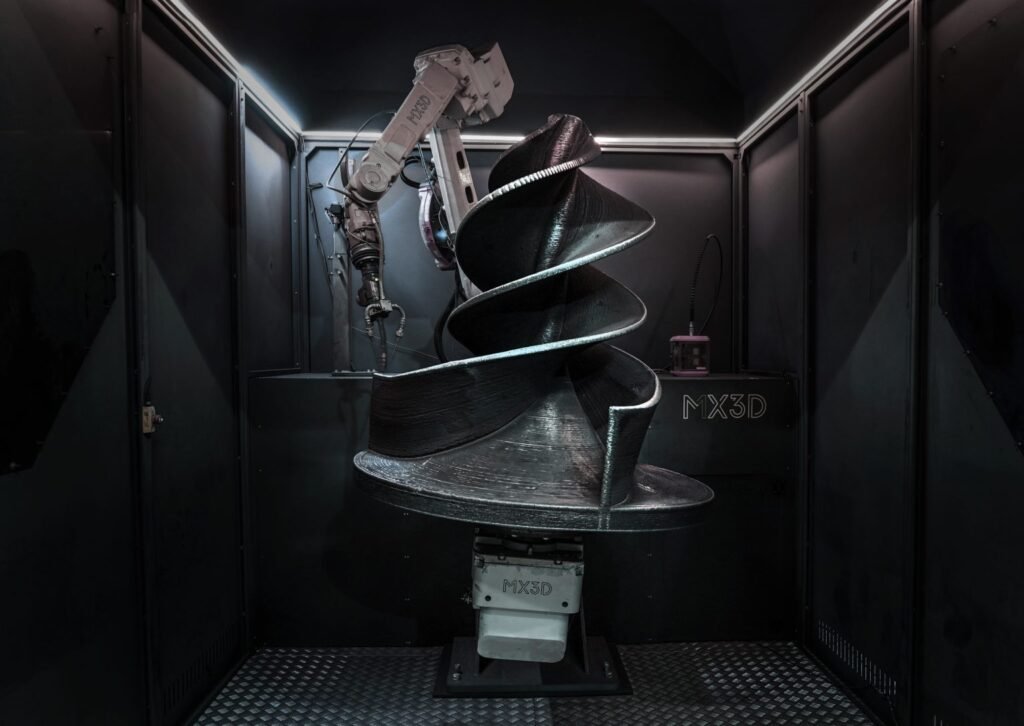
In May, MX3D, an Amsterdam-based company specializing in robotic metal 3D printing using Wire Arc Additive Manufacturing (WAAM), secured €7 million in a Series A funding round. The investment will support international deployment of its M1 Metal AM System and Print-on-Demand services. The M1 system developed by the Dutch firm allows manufacturers to produce large-scale, high-value metal parts in-house. The process uses WAAM to deposit metal layer by layer, reducing material waste by over 80% compared to traditional methods such as casting and forging. MX3D is active in the energy, maritime, and aerospace industries and has delivered systems or services to clients including BMW Group, Framatome, and the U.S. Army.
MX3D’s WAAM robotic arm printing a large-scale metal component. Photo via MX3D.
In January, Metal 3D printer manufacturer Eplus3D announced that it has delivered over 100 “super-meter” metal LPBF 3D printers globally. Nearly 40 of these systems, which include the EP-M2050, EP-M1550, and EP-M1250 models, feature X, Y, and Z axes all measuring over one meter. According to the Hangzhou-based company, these sales figures reinforce its leadership in the large-format, multi-laser metal 3D printer market. Eplus3D claims its success reflects a market trend of increasing multi-laser adoption in metal additive manufacturing.
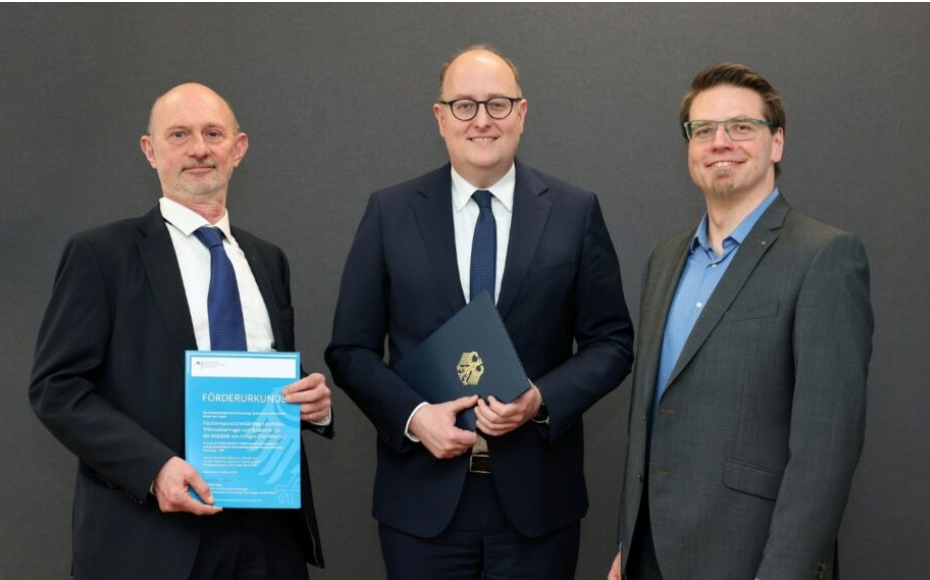
The Aachen-based Fraunhofer Institute for Laser Technology (Fraunhofer ILT) is to research titanium aluminide hydrogen reactors and heat exchangers. The
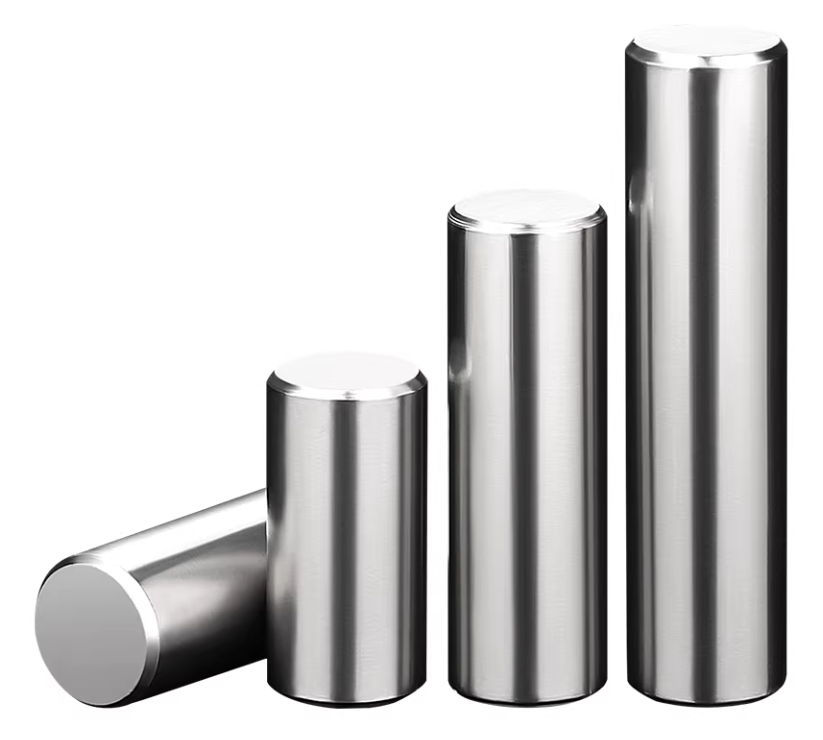
Step into a modern kitchen, open a refrigerator, walk into an office building elevator, or observe medical equipment—in these seemingly different scenarios, one material silently underpins our lives: Stainless Steel 304. As the most common and widely used grade of austenitic stainless steel, SS304 has become an “invisible champion” in industrial manufacturing and daily life, thanks to its excellent corrosion resistance, good formability, and outstanding hygienic properties.
Since stainless steel was invented in the early 20th century, 304 stainless steel has evolved into the world’s most popular stainless steel variety, accounting for approximately 50% of the stainless steel market share. From aerospace to food processing, from architectural decoration to medical devices, this alloy occupies an irreplaceable position in modern materials science due to its unique combination of properties. This article will provide a comprehensive analysis of the chemical composition, mechanical properties, application fields, processing techniques, and selection guidelines for 304 stainless steel, offering a thorough reference for engineers, designers, purchasers, and general consumers.
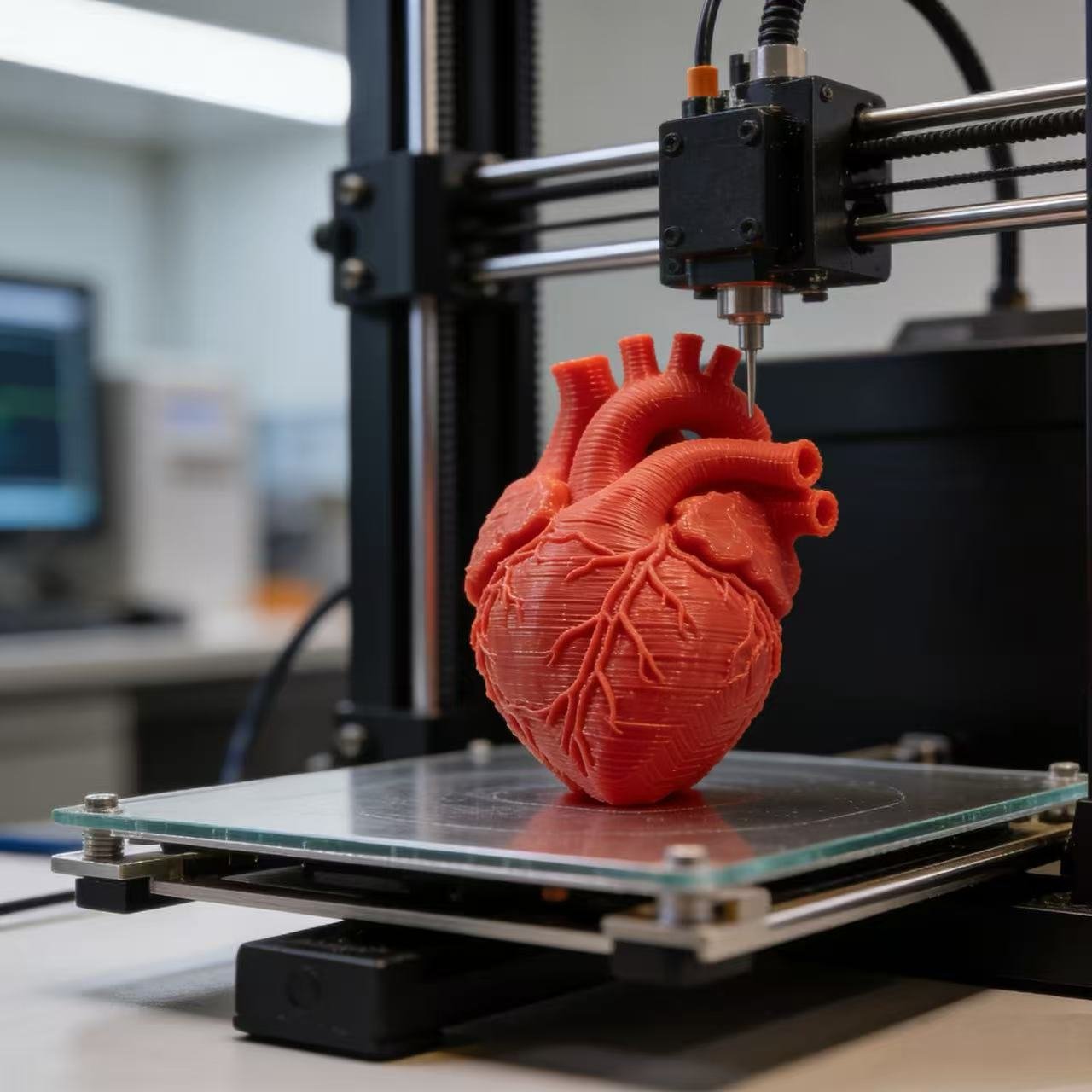
In the high-stakes world of pediatric cardiology, surgeons often operate with limited information, navigating tiny, complex, and uniquely malformed hearts.