chinese_new_year_PNG87

Ford Uses On-Site 3D Printing to Boost Mustang GTD Performance

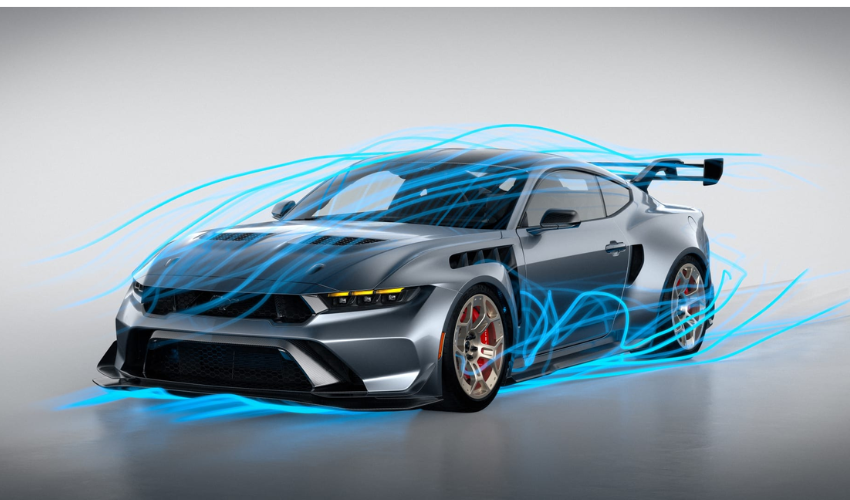
Ford has taken a major step forward in automotive performance with the launch of the 2025 Mustang GTD. The track-focused supercar, equipped with a supercharged 5.2L V8 and advanced carbon fiber bodywork, achieved a stunning 6:52.072 lap at Germany’s Nürburgring, beating every Ferrari on the circuit. The secret behind this leap in performance? Tiny 3D-printed “hood flicks” that were developed and installed during testing at the track.

The hood flicks, small raised pieces positioned around the vents on the car’s hood, subtly reshaped airflow to increase front-end downforce without adding drag. Chief Program Engineer Greg Goodall explained that these parts allowed the GTD to reach sub-seven-minute lap times, something that would have been very difficult without the on-the-fly 3D printing. The design process for the hood flicks was remarkably fast, with eight iterations tested in just a couple of weeks.

The use of 3D printing allowed Ford engineers to experiment with complex aerodynamic tweaks far later in development than would have been possible using traditional manufacturing. “We were able to design and test these parts at the track itself, which saved valuable time and let us optimize performance directly under real-world conditions,” said Goodall. The result is a car that blends raw American power with precision engineering and modern additive manufacturing.

Ford has been a longtime adopter of 3D printing, starting with prototyping and design validation and now extending to end-use parts and tooling production. From functional prototypes in the all-electric Explorer to high-performance components for Red Bull Racing’s Formula 1 team, the automaker leverages additive manufacturing to create complex metal and polymer parts that withstand extreme conditions.

The Mustang GTD demonstrates how 3D printing can move beyond prototyping to deliver tangible performance advantages. By enabling rapid iteration, localized production, and precise aerodynamic tuning, the technology has helped Ford turn one of its most iconic muscle cars into a true global competitor on the racetrack.

This milestone shows how additive manufacturing is reshaping automotive engineering, not only by shortening development cycles but also by allowing innovations that would have been impossible with conventional methods. The 2025 Mustang GTD is now a showcase of what happens when horsepower meets 3D printing.

How do you feel about Ford’s incorporation of 3D printing?

*This article originally appeared on [3dnatives.com]. [Joseph K] is the original author of this piece.

Have parts to make? Get free instant quote today.

Share the Post:

Related Posts

Knowledge Base
Stainless Steel 304: Comprehensive Analysis of Performance, Applications, and Selection Guide

Step into a modern kitchen, open a refrigerator, walk into an office building elevator, or observe medical equipment—in these seemingly different scenarios, one material silently underpins our lives: Stainless Steel 304. As the most common and widely used grade of austenitic stainless steel, SS304 has become an “invisible champion” in industrial manufacturing and daily life, thanks to its excellent corrosion resistance, good formability, and outstanding hygienic properties.
Since stainless steel was invented in the early 20th century, 304 stainless steel has evolved into the world’s most popular stainless steel variety, accounting for approximately 50% of the stainless steel market share. From aerospace to food processing, from architectural decoration to medical devices, this alloy occupies an irreplaceable position in modern materials science due to its unique combination of properties. This article will provide a comprehensive analysis of the chemical composition, mechanical properties, application fields, processing techniques, and selection guidelines for 304 stainless steel, offering a thorough reference for engineers, designers, purchasers, and general consumers.

Read More

Join our newsletter to stay updated

Scroll to Top