🚀 July 11 Update – Batch Edit, Re-Quote, Tiered Pricing & Notifications Are Here
Dear Valued Customer,
We've just released another major update with improvements across the Instant Quote, Cart, Checkout, Dashboard, and Order Management.
As we're continuously shipping new features, there may still be occasional bugs or unexpected issues. If you find anything that doesn't work as expected, please let us know—we truly appreciate your feedback and will fix it as quickly as possible.
🛠 Instant Quote
🏷 Material Tags added to help you choose the most suitable material. 📊 Tiered Pricing is now available. Instantly compare quantity discounts and select the best pricing option. ✏️ Batch Edit for multiple parts. Update configurations or delete multiple parts at once.
🛒 Cart
🔄 Re-Quote any part directly from your cart and continue editing before placing your order. 🛍 Mini Cart added to the header, allowing you to quickly view your cart from any page.
📦 Orders
♻️ Add to Quote and Add All to Quote are now available for existing orders. Reuse previous parts, make changes, and generate a new quote in just one click.
💳 Checkout
🌍 Customs & Shipping Options added.
Choose how you want customs declaration handled. Set your preferred Customs Value. Tell us your Expected Shipping Date.
🔔 Dashboard
🔔 Notifications keep you updated on order status and important activities. 📢 Announcements provide the latest ProtoTi news and product updates.
⚡ Performance & Improvements
We've also fixed and optimized numerous issues across:
Instant Quote
Checkout
Order Details
making the overall experience smoother and more reliable.
💬 Found a bug or have a feature request?
We're releasing new features rapidly, and your feedback helps us improve faster.
In November 2025, Windsor, Ontario, Canada, launched a groundbreaking construction project—the groundbreaking of the country’s first multi-story 3D-printed student residence. Led by the University of Windsor, the building will provide seven student units with a total of 25 beds and serve as a “living laboratory” for engineering students and faculty for research and educational purposes.
Located at 1025 California Ave, adjacent to the university’s athletic center and sports fields, the project aims to achieve “net-zero energy” and demonstrate new pathways for sustainable, low-cost housing construction in the future. Spearheaded by Dr. Sreekanta Das and his team from the Faculty of Engineering at the University of Windsor, the project received technical support from Printerra, a leading Canadian 3D printing construction company, as well as CAD 250,000 in funding from Desjardins Ontario Credit Union. Additionally, the Canadian federal government contributed CAD 2 million through FedDev Ontario, providing crucial public funding for the project.
Dr. J.J. McMurtry, President and Vice-Chancellor of the University of Windsor, stated, “This project demonstrates what is possible when government, academia, and industry align their goals and collaborate. With support from FedDev Ontario and exceptional partners, we are showcasing how 3D printing can make housing construction faster, more affordable, and more environmentally friendly.”
Printerra Introduces COBOD Technology to North America
The construction utilizes the BOD 2 gantry-style 3D printing system developed by Danish company COBOD, operated by Printerra on-site. The equipment covers a printing area of 231 square meters, enabling the on-site printing of entire building walls and significantly reducing transportation, logistics, and labor requirements. Leigh Newman, CEO of Printerra, expressed, “We are thrilled to participate as an innovation partner in this forward-looking project. This milestone underscores Printerra’s leadership in advancing the industrialization of additive manufacturing in construction.”
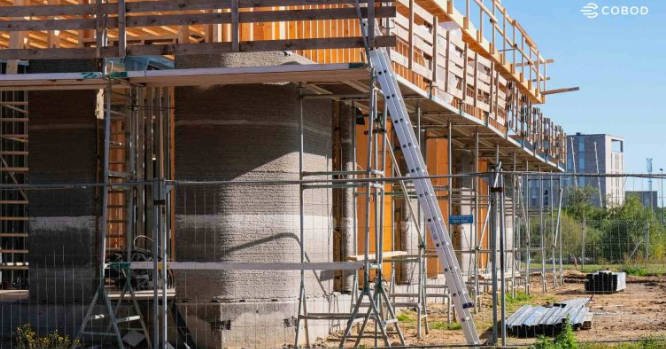
The COBOD technology has been applied to the wall printing of a student dormitory building in Holstebro, Denmark.
Europe’s Largest 3D-Printed Housing Project Enters Interior Finishing Phase
COBOD’s technology is also making strides in Europe. In Holstebro, Denmark, 3DCP Group is leading the construction of Europe’s largest 3D-printed residential complex—a student housing project comprising six buildings with a total floor area of 1,654 square meters, each accommodating six student apartments.
The completion of Canada’s first 3D-printed student residence at the University of Windsor marks a new practical phase for additive manufacturing in construction in North America. Integrating academic research, industry expertise, and public investment, the project emphasizes sustainability and affordability in housing. With COBOD equipment being deployed across Europe and North America, the construction industry is undergoing a profound transformation driven by speed, cost efficiency, and environmental responsibility.
*This article originally appeared on China 3D Printing News Network. China 3D Printing News Network is the original author of this piece.