🚀 July 11 Update – Batch Edit, Re-Quote, Tiered Pricing & Notifications Are Here
Dear Valued Customer,
We've just released another major update with improvements across the Instant Quote, Cart, Checkout, Dashboard, and Order Management.
As we're continuously shipping new features, there may still be occasional bugs or unexpected issues. If you find anything that doesn't work as expected, please let us know—we truly appreciate your feedback and will fix it as quickly as possible.
🛠 Instant Quote
🏷 Material Tags added to help you choose the most suitable material. 📊 Tiered Pricing is now available. Instantly compare quantity discounts and select the best pricing option. ✏️ Batch Edit for multiple parts. Update configurations or delete multiple parts at once.
🛒 Cart
🔄 Re-Quote any part directly from your cart and continue editing before placing your order. 🛍 Mini Cart added to the header, allowing you to quickly view your cart from any page.
📦 Orders
♻️ Add to Quote and Add All to Quote are now available for existing orders. Reuse previous parts, make changes, and generate a new quote in just one click.
💳 Checkout
🌍 Customs & Shipping Options added.
Choose how you want customs declaration handled. Set your preferred Customs Value. Tell us your Expected Shipping Date.
🔔 Dashboard
🔔 Notifications keep you updated on order status and important activities. 📢 Announcements provide the latest ProtoTi news and product updates.
⚡ Performance & Improvements
We've also fixed and optimized numerous issues across:
Instant Quote
Checkout
Order Details
making the overall experience smoother and more reliable.
💬 Found a bug or have a feature request?
We're releasing new features rapidly, and your feedback helps us improve faster.
The findings are particularly beneficial on challenging materials for LPBF such as copper, silver and tungsten.
In a study published on ScienceAdvances, US researchers from Stanford Nano Shared Facilities (SNSF) and Lawrence Livermore National Laboratory (LLNL), with support from the National Science Foundation and the US Department of Energy, have demonstrated the high absorptivity benefits of nanotextured powders in LPBF of challenging metals such as copper, silver and tungsten.
Metal additive manufacturing (AM) is a revolutionary process, but printing metals like copper, silver, and tungsten is challenging due to their high reflectivity. These metals do not absorb enough laser energy during Laser Powder Bed Fusion (LPBF), leading to inefficient energy use, poor part quality, and high power requirements. However, a new process using nanotextured metal powders can overcome these challenges by significantly enhancing powder absorptivity and improving the efficiency of additive manufacturing.
Experimental and simulated absorptivity enhancement in textured powder. (A) Representative time versus temperature data from calorimetry experiments performed at 175 W and 656 mm/s. Data show an increase in peak substrate temperature in etched powder relative to as-purchased powders. Inset shows in situ calorimetry experimental setup. (B) Effective absorptivity in as-purchased (blue) and etched copper powders at a laser power of 175 W and two speeds, 100 and 656 mm/s, showing an increase in effective absorptivity of etched powder relative to as-purchased copper powders at both scan speeds. Similar results were shown for AgCu and W as-purchased and etched powders. (C) Sample particle cross-section used for EM simulations. (D) Normalized magnetic field and (E) electric field intensities showing localized fields in surface grooves. (F) Representative simulation domain for ray tracing calculations. The colors of the rays represent the number of reflections of each ray, where incident rays are assigned a value of 0. The red spots on the powder particle surfaces indicate regions of enhanced absorptivity, covering a surface area fraction ϕ. (G) Absorptivity map from ray tracing simulations of bimodally distributed Cu powder diameter. Dashed lines are iso-absorptivity contours corresponding to the measured absorptivity of Cu powders at 656 mm/s. (H) Simulation results show that absorptivity improves faster in bimodally distributed powders than in uniformly distributed powder. The absorptivity is normalized by the respective values at ϕ = 0 for each powder distribution.
Metals like copper and silver reflect a large portion of laser energy, which reduces heat localization needed for proper fusion. Refractory metals, such as tungsten, have high melting points and thermal conductivities, leading to cracking during cooling. Attempts to print these metals often involve increasing laser power or adding alloying elements. However, these methods are costly, reduce material properties, and can damage printing equipment.
What are nanotextured powders?
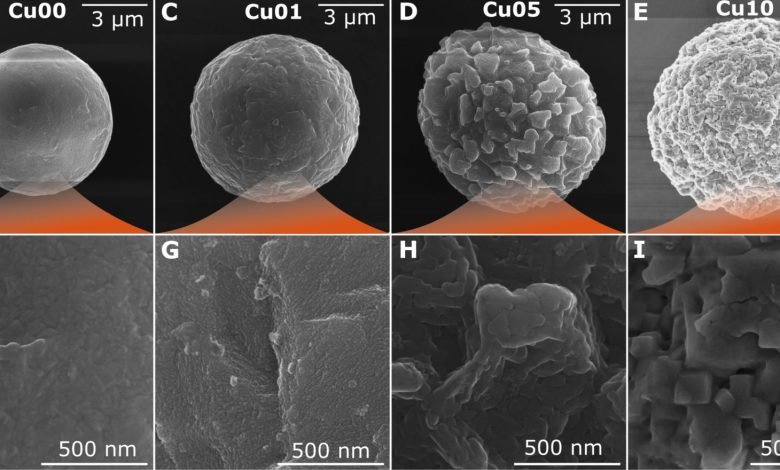
Nanotextured powders are metal powders modified with nanoscale grooves on their surface. These grooves, created using chemical etching, increase the surface area and enhance the interaction between the laser and the powder. This leads to significantly higher laser energy absorption without altering the material’s chemical composition.
The etching process involves submerging metal powders in a solution that creates nanoscale features on their surface. For example, copper powders were etched using a ferric chloride (FeCl₃) solution, which produced powders with different levels of surface roughness based on the etching time. The enhanced absorptivity of the nanotextured powders results from two main factors. One is Plasmonic Resonance: the nanoscale grooves concentrate light energy, resulting in localized heating and higher absorption. The other is Multiple Scattering Events: here the textured surface causes multiple reflections of laser energy, increasing overall absorption.
Benefits of nanotextured powders in AM
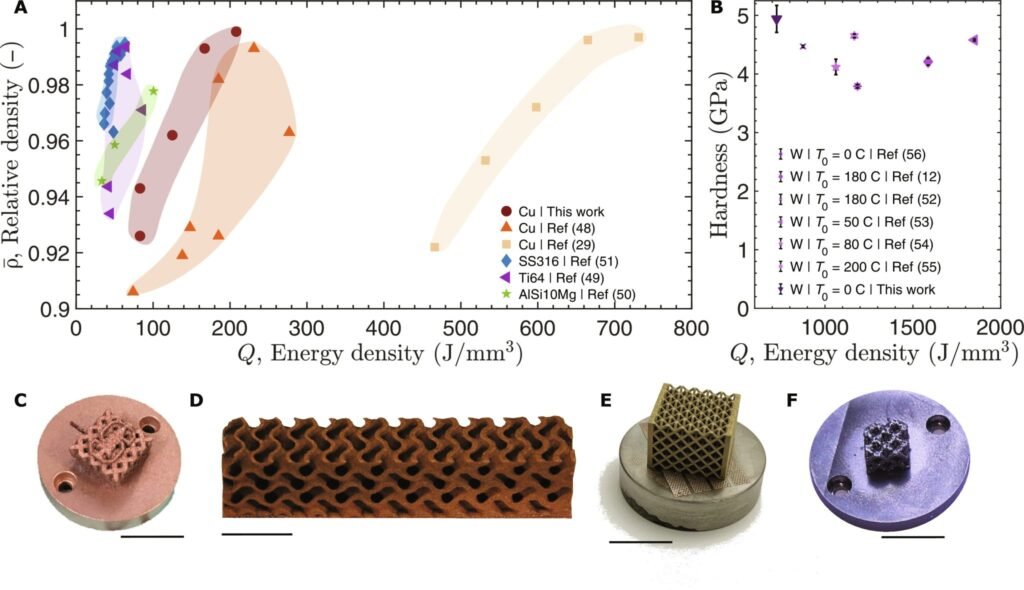
Nanotextured powders enable the printing of metals like copper and tungsten at significantly lower energy densities. For example, pure copper was printed at a 92% relative density using just 83 J/mm³ of energy, which is much lower than traditional methods.
At lower laser powers, the enhanced absorptivity of nanotextured powders leads to improved part quality with fewer defects. This process also minimizes the need for post-processing, making it more cost-effective.
Low energy density printing of copper and exemplary structures using textured powders. (A) Readily printable materials such as SS316, Ti64, and Al alloys are printable with full relative densities ( ρ 0.99) using low energy densities (Q≤ 80 J/mm3). We demonstrate the ability to push the processing conditions of copper to lower energy densities, relative to previous works, using high absorptive Cu05. Shaded areas show qualitative grouping of data. (B) Indentation hardness of tungsten cylinder prints contextualized in energy density. The nanotextured W prints result in a hardness of ~5 GPa, a value similar to other measurements of additively manufactured pure W, but without the need to preheat powders up to 200 C (see legend). (C and D) Printing of an octet lattice and a triply periodic minimal surface using Cu05 powders at 87 J/mm3. (E) Octet AgCu printed at 400 J/mm3. (F) Octet W structure printed using W01 at 725 J/mm3. Scale bars, 10 mm.
This method has been successfully applied to copper, silver-copper alloys, and tungsten, demonstrating its versatility for a wide range of high-reflectivity and refractory metals.
With nanotextured copper powders, the researchers achieved high-density parts at energy levels significantly lower than traditional methods. At 100 W and 300 mm/s, a relative density of 92.6% was reached, compared to 85.6% for non-textured powders. For tungsten, the nanotextured powders enabled successful printing at lower laser powers, resulting in high-density parts and improved mechanical properties. This marks a breakthrough in printing refractory metals.