🏮 Holiday Notice – Mid-Autumn Festival & National Day
Dear Valued Customer,
As China's Mid-Autumn Festival (September 25–27) and National Day Holiday (October 1–7) are approaching, our production and logistics operations will be affected during this period. 🏮✨
📦 Orders Placed by September 30
😊 Priority Handling Orders placed on or before September 30 will be given priority.
🚚 Production & Shipping Arrangement We will do our best to arrange production before the holiday and ship your orders as soon as possible after the holiday.
⏰ Orders Placed During October 1–7
🕒 Additional Lead Time Orders placed between October 1 and October 7 may experience an additional lead time of approximately 8–10 days due to the holiday schedule.
🚀 Planning an Upcoming Project?
📅 Order in Advance If you have an upcoming project, deadline, or time-sensitive order, we recommend placing your order in advance to help avoid potential delays.
💛 Thank You for Your Understanding
Thank you very much for your understanding, patience, and continued support. We truly appreciate your trust in us and will continue doing our best to provide you with reliable service.
🌕Wishing you all a smooth and successful work schedule, and good health and happiness to you and your family!
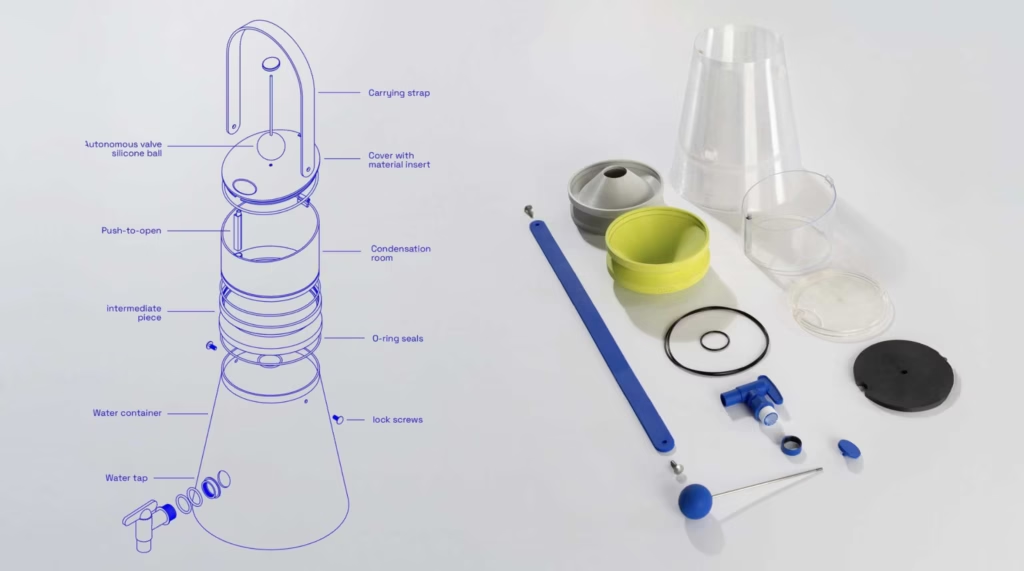
focusing on the Water from Air project developed at the Münster University of Applied Sciences. Using metal-organic frameworks (MOFs) and 3D printing technologies such as FDM and SLA, the portable water collection device transforms atmospheric moisture into clean, distilled drinking water. Designed as a sustainable, mobile water producer, it demonstrates the potential of atmospheric water generation (AWG), food-safe PETG containers, and modular design for low-income countries, remote communities, and future decentralized water supply systems.
Limited access to clean drinking water is a serious issue that affects over 2 billion people globally, particularly in low-income countries. With global warming and more and more extreme weather events occurring, access to clean drinking water will only become more of a challenge. One, largely untapped, source of freshwater is the atmosphere, which holds more water than all of the planet’s rivers. In a bid to leverage this and address challenges to clean drinking water, a pair of students from Münster University of Applied Sciences developed a novel water collection device that converts moisture from the air into potable water.
The project, called “Water from Air”, is spearheaded by Louisa Graupe and Julika Schwarz and consists of a portable device that uses metal-organic frameworks (MOFs) to absorb water molecules from the air and then release them into a carafe-like container as a liquid. MOFs are at the cutting-edge of material science research and can be defined as porous materials made up of of metal ions linked by organic ligands. In simpler terms, these materials can effectively function as sponges in the air.
To date, the research duo have developed a 3D printed prototype for the device, which can yield up to six liters of water every 24 hours. The system itself is a self-contained structure designed for portability and simple usage so that it can easily be deployed in remote locations or urban areas with limited water infrastructure. “Water from Air is designed as a mobile water producer and storage unit that can be used flexibly in private households, regardless of geographical and social circumstances—a practical solution and application option for people all over the world,” the designers write.
In developing the the prototype, various 3D printing technologies were used. For instance, the pair leverages FDM 3D printing and transparent PETG filament to print the water container base (PETG is a food-safe material). They also used a colored PETG filament for an intermediate component. The device’s container and lid were 3D printed using SLA, while the carrying strap and valve were molded from silicone.
To function, the MOF material is placed inside the lid, which is left open for an hour. According to Graupe and Schwarz, the MOFs absorb little to no pollutants from the air so additional filtering is not required. After an hour, the container is closed for an additional hour, which allows the water in the air to condense, resulting in naturally distilled, safe-to-drink water. From there, a valve connecting the upper portion of the device to the collection device is opened, allowing the water to pour through. The container section also integrates a tap for easy access. In total, a two-hour cycle using 500g of MOFs in 80% humidity can produce 500 ml of water, for a total of 6 liters per 24 hours. The device can also be used in less humid conditions.
While still in its prototype stage, the Water from Air project represents an exciting development in the use of MOFs in a real-world setting. This is also true for 3D printing, which not only played an important role in designing the device but enables the modularity of the system and could make it easy for parts to be replaced if something fails.
*This article originally appeared on voxelmatters. Tess Boissonneault is the original author of this piece.