3D-printed pyrolytic carbon scaffolds usher in a new era of bone regeneration; programmable biomaterials breakthroughs emerge

The research team at IMDEA Materials Institute has published a groundbreaking study in Small Structures, marking the first successful fabrication of an all-carbon bone scaffold using a combination of 3D printing and high-temperature pyrolysis. This innovative approach eliminates the need for traditional additives, achieves mechanical properties comparable to natural bone, and enables active regulation of cell growth.

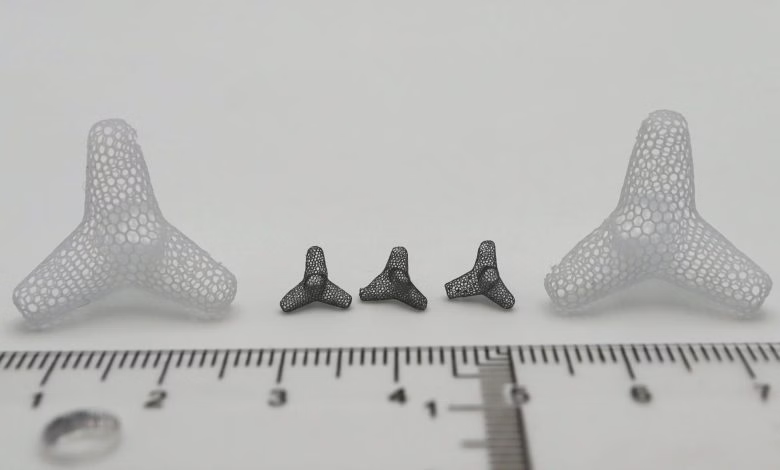
The scaffolds were fabricated by the IMDEA Materials Institute using polyethylene glycol diacrylate (PEGDA)

Breakthrough Highlights:

The IMDEA Materials Institute team has, for the first time, developed all-carbon bone scaffolds through 3D printing combined with high-temperature pyrolysis, moving away from the reliance on conventional composite additives. These scaffolds match the mechanical properties of natural bone and actively guide cellular behavior.

Core Technical Approach:

Innovative Manufacturing Process:
  • UV-curing 3D printing of PEGDA (polyethylene glycol diacrylate) resin to form precise scaffold architectures
  • High-temperature pyrolysis at 800°C in an oxygen-free environment, converting the polymer into a pure carbon framework (with shrinkage rates of up to 80%)
  • This approach overcomes the limitations of traditional carbon materials that require polymer composites, enabling direct formation of pure carbon microlattices
Performance Tuning Strategy:

Programmable thermal gradient from 500–900°C allows control over scaffold properties:

  • High-temperature region (900°C): Enhanced conductivity, elastic modulus reaches 14 GPa, comparable to cortical bone
  • Low-temperature region (500°C): Increased oxygen-containing surface groups, promoting 1.9× cell proliferation

Maintains complex bone-mimicking porosity (~200 µm) with resolution exceeding conventional 3D printing techniques

Disruptive Advantage:

Four-Dimensional Adaptability: Simultaneously fulfills clinical requirements for:

  • Mechanical strength (~900 MPa compressive strength)
  • Geometric precision (<50 µm features)
  • Surface bioactivity (no bio-coatings needed)
  • Imaging compatibility (no MRI artifacts)

Dynamic Regional Control: Enables a single scaffold to feature differentiated thermal treatment in different zones:

  • Bone-growth zones with high cell activity
  • Load-bearing zones with reinforced mechanical strength

Industrialization Outlook:

This technology has been incorporated into the EU Marie Skłodowska-Curie 3D-CARBON Project, paving the way for clinical translation of biodegradable carbon-based bone implants. Compared to traditional metal implants (which risk stress shielding) or ceramics (which face machining limitations), this scaffold system offers precise bioadaptability, potentially ushering in a new era of “programmable biomaterials” in orthopedic repair. The team is currently collaborating with medical enterprises to develop customized bone repair solutions.

*This article originally appeared on VoxelMatters. Edward Wakefield is the original author of this piece.

Have parts to make? Get free instant quote today.

Share the Post:

Related Posts

Knowledge Base
Protecting mechanical processing parts with “armor”: Comprehensive analysis of galvanizing surface treatment process, advantages and disadvantages, and application selection

Abstract: In the field of mechanical manufacturing, the durability of parts directly determines the lifespan and reliability of the products. Galvanization, as a classic, efficient, and cost-effective metal surface treatment process, provides excellent rust and corrosion protection for steel parts. This article will deeply explore all aspects of galvanizing for mechanical processing parts, including its core principles, detailed comparisons of various processes (electro-galvanizing, hot-dip galvanizing, mechanical galvanizing, etc.), the protective mechanism of the galvanized layer, advantages and disadvantages analysis, subsequent treatments (such as passivation, phosphating), quality inspection standards, and how to select the most suitable galvanizing process based on the characteristics of your parts, helping you equip precision-machined parts with the strongest “armor”.

Read More
Knowledge Base
Complete Guide to Part Polishing: From Process Principles to Application Effects, Comprehensive Analysis of CNC Metal Polishing Technology

In the field of precision manufacturing, part polishing is a crucial step that determines the performance, lifespan, and appearance of products. Whether it is the core components of automotive engines, the precise components of medical devices, or the micro parts of electronic equipment, after professional polishing treatment, not only can the surface smoothness be improved, the friction loss be reduced, but also the corrosion resistance be enhanced, laying a solid foundation for subsequent assembly and use. This article will start from the basic understanding of part polishing, deeply analyze the mainstream polishing processes, material adaptation schemes, common problem solutions, equipment selection techniques, and industry development trends, providing comprehensive and practical reference guidelines for manufacturing enterprises, technicians, and procurement professionals.

Read More

Join our newsletter to stay updated

Scroll to Top