🚀 July 11 Update – Batch Edit, Re-Quote, Tiered Pricing & Notifications Are Here
Dear Valued Customer,
We've just released another major update with improvements across the Instant Quote, Cart, Checkout, Dashboard, and Order Management.
As we're continuously shipping new features, there may still be occasional bugs or unexpected issues. If you find anything that doesn't work as expected, please let us know—we truly appreciate your feedback and will fix it as quickly as possible.
🛠 Instant Quote
🏷 Material Tags added to help you choose the most suitable material. 📊 Tiered Pricing is now available. Instantly compare quantity discounts and select the best pricing option. ✏️ Batch Edit for multiple parts. Update configurations or delete multiple parts at once.
🛒 Cart
🔄 Re-Quote any part directly from your cart and continue editing before placing your order. 🛍 Mini Cart added to the header, allowing you to quickly view your cart from any page.
📦 Orders
♻️ Add to Quote and Add All to Quote are now available for existing orders. Reuse previous parts, make changes, and generate a new quote in just one click.
💳 Checkout
🌍 Customs & Shipping Options added.
Choose how you want customs declaration handled. Set your preferred Customs Value. Tell us your Expected Shipping Date.
🔔 Dashboard
🔔 Notifications keep you updated on order status and important activities. 📢 Announcements provide the latest ProtoTi news and product updates.
⚡ Performance & Improvements
We've also fixed and optimized numerous issues across:
Instant Quote
Checkout
Order Details
making the overall experience smoother and more reliable.
💬 Found a bug or have a feature request?
We're releasing new features rapidly, and your feedback helps us improve faster.
Researchers have developed a 3D-printed aerogel material that uses sunlight to convert seawater into drinking water. The sponge-like structure contains microscopic vertical channels that enable efficient water evaporation at various scales. The team published their findings in ACS Energy Letters.
Unlike earlier materials, this 3D-printed structure is filled with microscopic vertical channels that enable it to efficiently evaporate water, even at larger scales. During outdoor testing, the sponge produced potable water in just hours, all without electricity or complex infrastructure.
Turning Sunlight Into Freshwater
Most of the water on Earth is found in the oceans, but it’s far too salty to drink. While desalination plants can remove salt and make seawater drinkable, they typically use a lot of energy. Now, researchers have developed a promising new material that could change that.
Reporting in ACS Energy Letters, a team of scientists created a sponge-like structure filled with long, microscopic air channels that harness sunlight to turn saltwater into fresh, clean water. In an outdoor test, this simple system—just the sponge and a clear plastic cover—successfully produced drinkable water using only natural sunlight. It’s a step toward making low-energy, sustainable desalination more accessible.
From Loofahs to Aerogels: The Evolution of Solar Sponges
Scientists have been experimenting with sun-powered materials for water purification for some time. One earlier example used a loofah-inspired hydrogel filled with special polymers. When exposed to sunlight, it heated up and released clean water vapor from polluted water. Hydrogels like this are soft and filled with liquid, but there’s another class of materials—called aerogels—that are more rigid.
These have solid pores and can move water or vapor through their structure. Aerogels have shown promise for desalination, but they often lose efficiency as they scale up in size. To solve this problem, researcher Xi Shen and colleagues set out to design a new type of aerogel that stays just as effective whether it’s small or large.
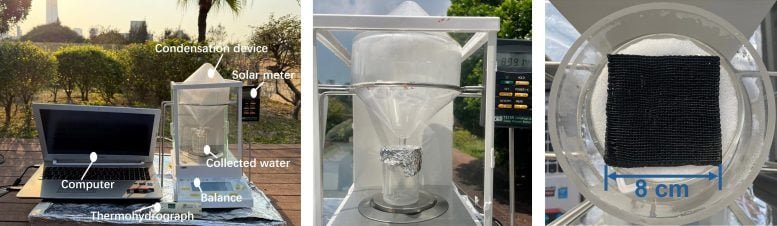
A custom-made setup removes salt from seawater in natural sunlight, using a beaker of seawater, a black piece of aerogel, and a curved plastic cap that drips into a funnel and beaker. (Credit: ACS Energy Letters)
3D-Printed Sponge Aerogel With Microscopic Channels
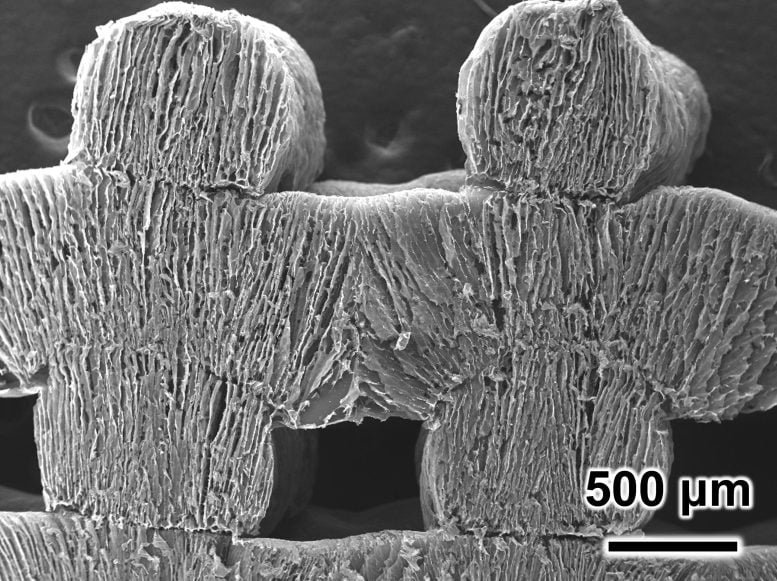
The researchers made a paste containing carbon nanotubes and cellulose nanofibers and then 3D-printed it onto a frozen surface, allowing each layer to solidify before the next was added. This process formed a sponge-like material with evenly distributed tiny vertical holes, each around 20 micrometers wide. They tested square pieces of the material, ranging in size from 0.4 inches wide (1 centimeter) to about 3 inches wide (8 centimeters), and found that the larger pieces released water through evaporation at rates as efficient as the smaller ones.
Real-World Test: Sunlight, Saltwater, and a Simple Setup
In an outdoor test, the researchers placed the material in a cup containing seawater, and it was covered by a curved, transparent plastic cover. Sunlight heated the top of the spongy material, evaporating just the water, not the salt, into water vapor. The vapor collected on the plastic cover as liquid, moving the now clean water to the edges, where it dripped into a funnel and container below the cup. After 6 hours in natural sunlight, the system generated about 3 tablespoons of potable water.
*This article originally appeared on SciTechDaily newsletter. BY AMERICAN CHEMICAL SOCIETY is the original author of this piece.