🚀 July 11 Update – Batch Edit, Re-Quote, Tiered Pricing & Notifications Are Here
Dear Valued Customer,
We've just released another major update with improvements across the Instant Quote, Cart, Checkout, Dashboard, and Order Management.
As we're continuously shipping new features, there may still be occasional bugs or unexpected issues. If you find anything that doesn't work as expected, please let us know—we truly appreciate your feedback and will fix it as quickly as possible.
🛠 Instant Quote
🏷 Material Tags added to help you choose the most suitable material. 📊 Tiered Pricing is now available. Instantly compare quantity discounts and select the best pricing option. ✏️ Batch Edit for multiple parts. Update configurations or delete multiple parts at once.
🛒 Cart
🔄 Re-Quote any part directly from your cart and continue editing before placing your order. 🛍 Mini Cart added to the header, allowing you to quickly view your cart from any page.
📦 Orders
♻️ Add to Quote and Add All to Quote are now available for existing orders. Reuse previous parts, make changes, and generate a new quote in just one click.
💳 Checkout
🌍 Customs & Shipping Options added.
Choose how you want customs declaration handled. Set your preferred Customs Value. Tell us your Expected Shipping Date.
🔔 Dashboard
🔔 Notifications keep you updated on order status and important activities. 📢 Announcements provide the latest ProtoTi news and product updates.
⚡ Performance & Improvements
We've also fixed and optimized numerous issues across:
Instant Quote
Checkout
Order Details
making the overall experience smoother and more reliable.
💬 Found a bug or have a feature request?
We're releasing new features rapidly, and your feedback helps us improve faster.
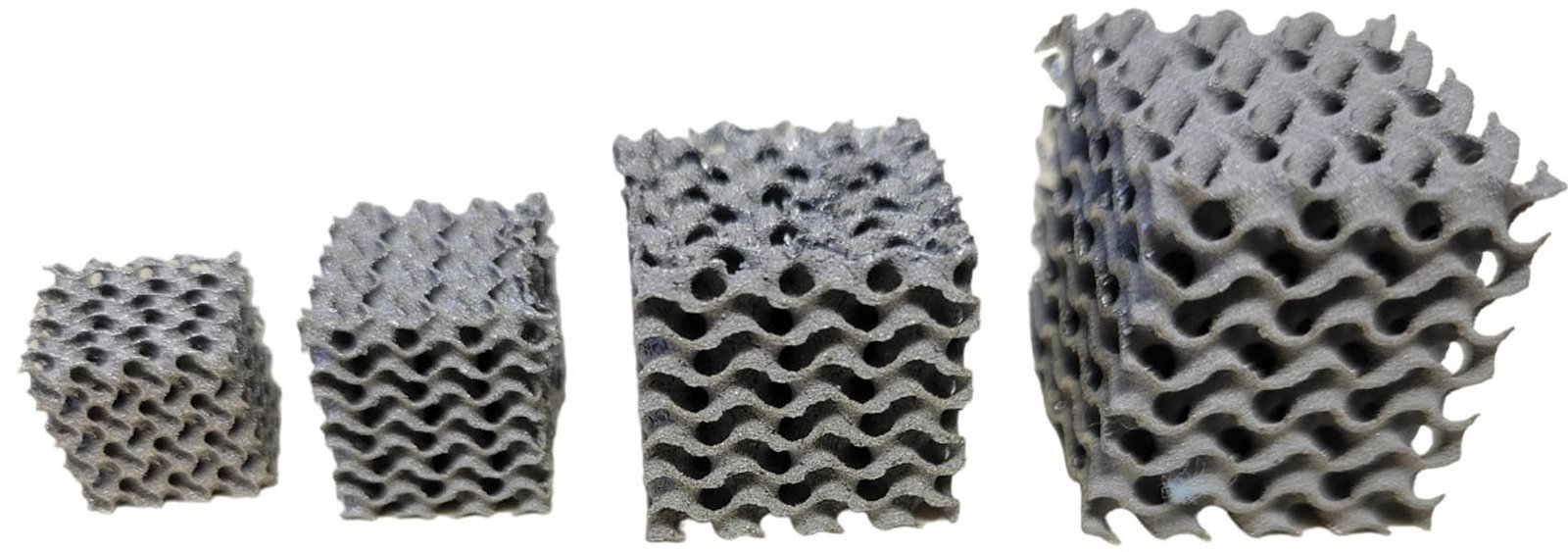
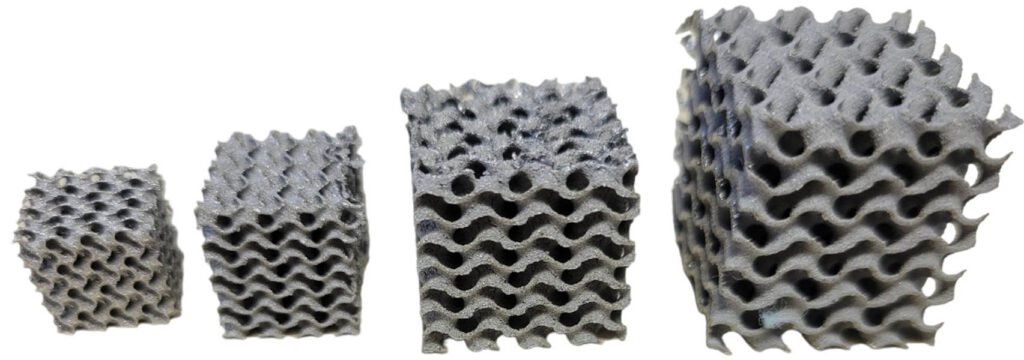
At US-based Binghamton University, a multidisciplinary research team led by Professor Seokheun “Sean” Choi is exploring new approaches to bacteria-powered biobatteries by integrating laser powder bed fusion (LPBF) 3D printing technology. Working in collaboration with Assistant Professor Dehao Liu, a specialist in LPBF from the Mechanical Engineering Department, the team used this metal AM method to produce stainless-steel microarchitectures with finely tuned porosity and surface roughness.
This design enhances bacterial colonization while facilitating nutrient delivery and waste removal—key challenges that have hindered carbon- and polymer-based anode materials in the past. “LPBF is ideal for biobatteries because it enables high-precision, customizable 3D structures with complex geometries, essential for maximizing surface area and energy density,” Liu explained.
The team also includes Electrical and Computer Engineering Assistant Professor Anwar Elhadad; Yang “Lexi” Gao, a current PhD student of Choi; and Liu’s PhD students Guangfa Li and Jiaqi Yang. The project is supported by a 2024 grant from the National Science Foundation.
Binghamton University researchers created a biobattery run on bacteria that produces 1 milliwatt in power. Image via Provided.
Inside the System: How Bacteria Generate Power
The biobattery generates electrical current through an electrochemical reaction driven by bacterial endospores—dormant microbial forms that can survive harsh environments and become active under suitable conditions. The system consists of three primary components: a cathode (positive electrode), an anode (negative electrode), and an ion-exchange membrane that facilitates electricity generation. For optimal performance, the anode must be three-dimensional, allowing bacteria to colonize densely while maintaining access to nutrients and enabling waste removal.
“A flat, two-dimensional anode is inefficient,” Choi said. “It restricts nutrient delivery to bacteria and hinders waste removal.”
To address this, the researchers used LPBF to fabricate 3D stainless-steel anodes with precise microstructural control, creating a more suitable environment for bacterial activity and energy generation. Traditional anode materials such as carbon or polymers typically have lower conductivity and are susceptible to thermal damage during processing—issues avoided by using metal-based structures.
“Two years ago, we started to use stainless steel mesh as an anode, because its conductivity is really good and it’s structurally very strong,” Choi said. “We were successful integrating the microbial fuel cell into electronics like this. The problem with commercially available mesh is that we cannot control the porosity and roughness of it. We’d just buy it and then drop in bacterial cells.”
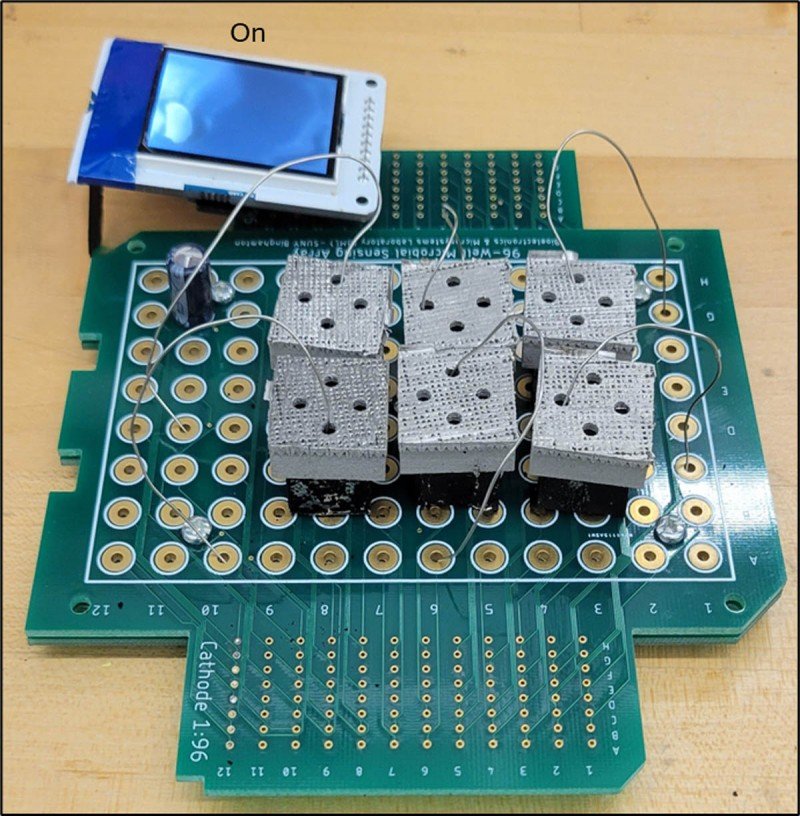
By connecting the biobatteries in series or parallel, researchers achieved 1 milliwatt of power. Photo via Provided.
Choi noted the potential of LPBF as it constructs 3D metal parts by selectively melting and solidifying thin layers of metal powder with a laser. By connecting multiple biobatteries in series or parallel, the team generated close to 1 milliwatt of power—enough to run a 3.2-inch thin-film transistor LCD screen—representing one of the most powerful outputs among Choi’s previous biobattery designs. Additionally, the stainless-steel structures enabled repeated reuse of bacterial cells without significant loss of performance.
Looking ahead, the team intends to streamline the manufacturing process by developing an integrated 3D printing approach that fabricates all biobattery components simultaneously. They also plan to implement power management strategies—comparable to those used in solar energy systems—to improve energy efficiency through better control of charging and discharging cycles.
Advances in 3D Printing with LPBF
The biobattery research at Binghamton University employs laser powder bed fusion, a technique that has recently seen important advancements beyond academic research, including in industrial applications.
For instance, ADDiTEC, a US-based developer of advanced metal additive manufacturing technologies, unveiled its first Laser Powder Bed Fusion system during RAPID + TCT 2025 in Detroit. The new platform, called Fusion S, expands the company’s technology offerings, which previously focused on Directed Energy Deposition (DED) and Liquid Metal Jetting (LMJ). With this release, ADDiTEC becomes one of the few companies globally offering three complementary metal additive manufacturing technologies.
Elsewhere, Munich-based 3D printer manufacturer EOS announced the launch of the EOS M 290 1kWlaser powder bed fusion 3D printer. An upgraded version of the EOS M 290 released back in 2014, this new offering incorporates a single 1kW laser and is designed for the serial production of copper and copper alloy parts. EOS’s partner company AMCM developed the M 290 1kW as part of its custom additive manufacturing portfolio. Targeted towards applications within the space, energy and transportation sectors, the new 3D printer has reportedly already received strong market demand.