

Chinese Deep Space Exploration Laboratory Advances In-Situ Lunar Construction With Regolith-Based 3d Printing

Researchers at the national-level Deep Space Exploration Laboratory in Hefei, Anhui Province, have created a 3D printing system that uses lunar soil sourced directly from the Moon to construct habitats. This research aims to enable on-site building of lunar research stations, reducing reliance on materials transported from Earth. “This printing breakthrough has validated the feasibility of using lunar soil as the sole raw building material, enabling true in-situ resource utilization and eliminating the need to transport any additional materials from Earth,” said Yang Honglun, senior engineer at the laboratory.

Experimental System and Technology

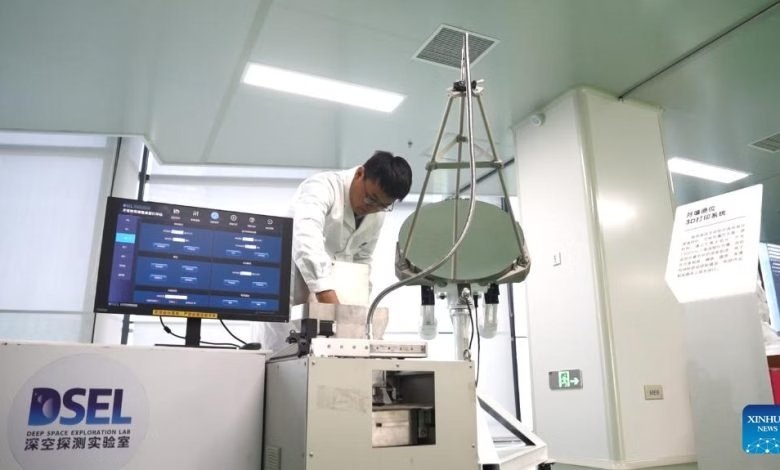
Yang explained that the system uses a high-precision reflective concentrator combined with flexible fiber-optic energy transmission to generate the intense heat required to fuse lunar regolith. The technology also incorporates flexible manufacturing capabilities, allowing it to produce standard bricks and custom-mold complex structures.

Yang Honglun, a senior engineer at the Deep Space Exploration. Laboratory. Photo via China SCIO.

Ground-based tests have confirmed the prototype’s capability to melt and form lines, surfaces, solid bodies, and complex shapes from lunar soil simulant. Additionally, comprehensive technical evaluations of the solar concentration, fiber-optic energy delivery, and regolith melting mechanisms have been successfully completed.

The researchers explained that initial technical challenges included achieving reliable solar energy concentration and shaping the regolith under conditions mimicking the lunar environment. A multidisciplinary team comprising experts in planetary science, materials science, mechanical engineering, energy dynamics, thermal physics, and optics worked together to solve these challenges related to energy capture, transmission, and material processing.

Future Applications and Impact

Looking forward, the prototype could enable the fabrication of lunar infrastructure such as roads, equipment platforms, and buildings. This contributes to the broader objective of sustainable, large-scale exploration of the Moon and the use of local resources. It also showcases technologies for harnessing lunar energy and extracting materials, potentially laying the groundwork for future lunar energy infrastructure.

Constructing Space Habitats Using Native Planetary Soil

In addition to the efforts of China’s Deep Space Exploration Laboratory, researchers at Texas A&M University and the University of Nebraska-Lincoln are advancing a synthetic lichen system designed to enable autonomous construction on Mars. Led by Dr. Congrui Grace Jin, the project utilizes the Red Planet’s native soil to create building materials without the need for human intervention. Funded by NASA’s Innovative Advanced Concepts program, this research tackles the challenge of constructing habitats millions of miles from Earth, where transporting construction supplies is costly and logistically difficult.

A synthetic habitat. Image via Texas A&M University College of Engineering

In 2017, NASA  also collaborated with the University of Central Florida (UCF) in order to find a way of 3D printing structures on Mars. The researchers concluded that Martian soil could be processed into a chamber which would be heated to approximately 3,000 degrees Fahrenheit (1648°C) to produce oxygen and molten metal.

Have parts to make? Get free instant quote today.

Share the Post:

Related Posts

Knowledge Base
Protecting mechanical processing parts with “armor”: Comprehensive analysis of galvanizing surface treatment process, advantages and disadvantages, and application selection

Abstract: In the field of mechanical manufacturing, the durability of parts directly determines the lifespan and reliability of the products. Galvanization, as a classic, efficient, and cost-effective metal surface treatment process, provides excellent rust and corrosion protection for steel parts. This article will deeply explore all aspects of galvanizing for mechanical processing parts, including its core principles, detailed comparisons of various processes (electro-galvanizing, hot-dip galvanizing, mechanical galvanizing, etc.), the protective mechanism of the galvanized layer, advantages and disadvantages analysis, subsequent treatments (such as passivation, phosphating), quality inspection standards, and how to select the most suitable galvanizing process based on the characteristics of your parts, helping you equip precision-machined parts with the strongest “armor”.

Read More
Knowledge Base
Complete Guide to Part Polishing: From Process Principles to Application Effects, Comprehensive Analysis of CNC Metal Polishing Technology

In the field of precision manufacturing, part polishing is a crucial step that determines the performance, lifespan, and appearance of products. Whether it is the core components of automotive engines, the precise components of medical devices, or the micro parts of electronic equipment, after professional polishing treatment, not only can the surface smoothness be improved, the friction loss be reduced, but also the corrosion resistance be enhanced, laying a solid foundation for subsequent assembly and use. This article will start from the basic understanding of part polishing, deeply analyze the mainstream polishing processes, material adaptation schemes, common problem solutions, equipment selection techniques, and industry development trends, providing comprehensive and practical reference guidelines for manufacturing enterprises, technicians, and procurement professionals.

Read More

Join our newsletter to stay updated

Scroll to Top