TOwCmtFIEL(1)

CROOM MEDICAL’S BIOFUSE: 3D PRINTED LATTICE TECHNOLOGY FOR ADVANCED ORTHOPEDIC IMPLANTS

Irish orthopedic manufacturing specialist Croom Medical has introduced Biofuse, a 3D printed porous ingrowth technology for orthopedic implants. Developed using laser powder bed fusion additive manufacturing, the platform allows OEMs to integrate lattice structures directly into implant geometries, in line with ASTM F1854 standards.

“By combining dense and targeted porous regions in a single manufacturing process, Biofuse supports implants that achieve both structural strength and effective bone integration, offering a solution for a wide range of orthopedic applications,” stated the company.

Precision Lattice Design for Bone Ingrowth

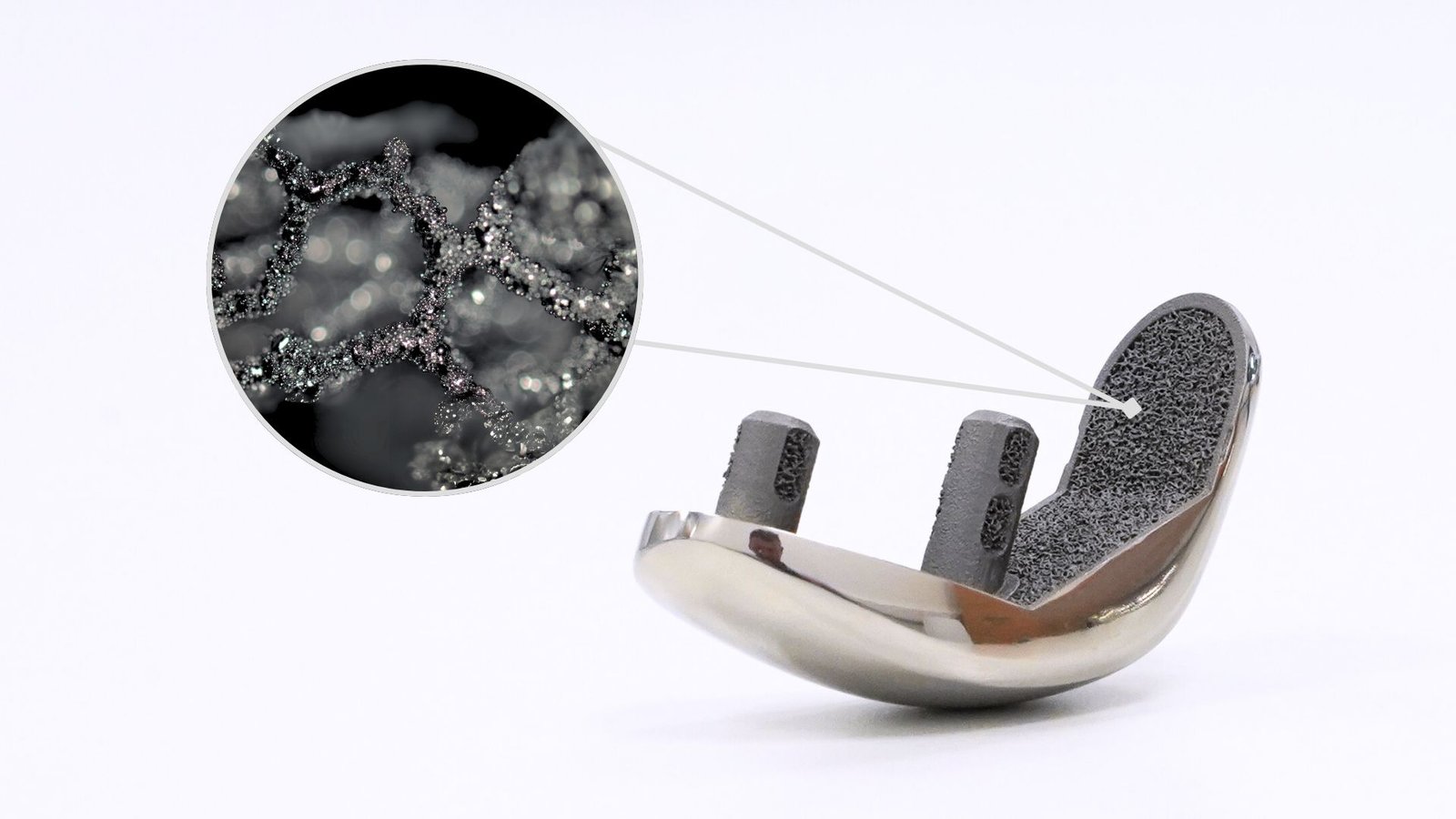
Croom Medical states that its Biofuse platform uses lattice engineering to provide control over implant characteristics such as pore size, porosity, and coefficient of friction. According to the company, the technology allows customization of implant designs intended to support both mechanical function and biological integration.

The firm reports that a higher coefficient of friction can aid initial stability by improving contact with surrounding bone, while interconnected porosity—adjustable between 50–80%—is designed to balance stiffness with fluid permeability to support vascularization and bone in-growth. Pore sizes ranging from 100–600 µm are cited as suitable for tissue integration and nutrient transport while maintaining structural integrity.

Croom Medical also indicates that Biofuse can combine solid and lattice regions in a single printing process and apply lattices selectively in complex or confined areas. This, the company suggests, may help OEMs reproduce existing designs or introduce new structures intended to improve fixation and manufacturability.

Applications, Performance, and Industry Impact

Croom Medical reports that Biofuse has been applied to various implant types, including unicondylar knees, interbody fusion cages, acetabular cups, femoral components for total knee arthroplasty, and revision cones. The company added that its collaborations with industry partners, together with developments in powder bed fusion technology, are intended to ensure lattice structures meet mechanical and regulatory requirements.

Femoral Component. Photo via Croom Medical.

3D Printing in Orthopedics

Beyond Biofuse, 3D printing is increasingly transforming orthopedic care. In June, Dimension Ortho, a provider of 3D printed orthotics, entered into a partnership with Rothman Orthopaedics, a major U.S.-based orthopedic practice recognized for its work in musculoskeletal care. This collaboration will enable Rothman to implement Dimension Ortho’s platform for customized bracing and fracture care across its clinical network, with the goal of elevating patient care standards.

Elsewhere, incotek’s Medical Division has secured a patent for a 3D printed screw designed to enhance bone ingrowth and offer greater customization for orthopedic procedures.  The patent (US 12,171, 464 B2) describes a screw with an integrated lattice structure that allows its mechanical properties to be adjusted based on surgical requirements and patient needs. Unlike traditional bone screws, which are typically machined from titanium with a smooth surface and a solid construction, this design introduces a more adaptable approach. 

*This article originally appeared on 3D Printing Industry. Paloma Duran is the original author of this piece.

Have parts to make? Get free instant quote today.

Share the Post:

Related Posts

Knowledge Base
Stainless Steel 304: Comprehensive Analysis of Performance, Applications, and Selection Guide

Step into a modern kitchen, open a refrigerator, walk into an office building elevator, or observe medical equipment—in these seemingly different scenarios, one material silently underpins our lives: Stainless Steel 304. As the most common and widely used grade of austenitic stainless steel, SS304 has become an “invisible champion” in industrial manufacturing and daily life, thanks to its excellent corrosion resistance, good formability, and outstanding hygienic properties.
Since stainless steel was invented in the early 20th century, 304 stainless steel has evolved into the world’s most popular stainless steel variety, accounting for approximately 50% of the stainless steel market share. From aerospace to food processing, from architectural decoration to medical devices, this alloy occupies an irreplaceable position in modern materials science due to its unique combination of properties. This article will provide a comprehensive analysis of the chemical composition, mechanical properties, application fields, processing techniques, and selection guidelines for 304 stainless steel, offering a thorough reference for engineers, designers, purchasers, and general consumers.

Read More

Join our newsletter to stay updated

Scroll to Top