CONTINUUM POWDERS AND HP AM PARTNER TO ADVANCE SUPERALLOYS

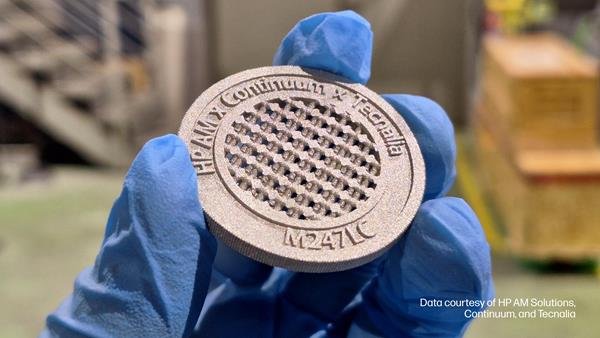
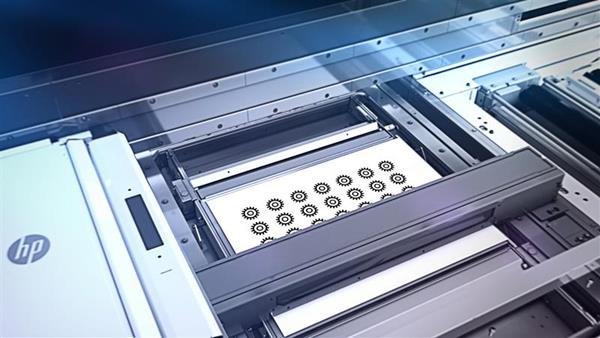
U.S.-based metal powder producer Continuum Powders and industrial 3D printing developer HP Additive Manufacturing Solutions (HP AM) have teamed up to accelerate the development of high-performance metal alloys using HP’s Metal Jet S100 Printing Solution. The partnership initially focuses on OptiPowder M247LC, a low-carbon, nickel-based superalloy designed for high-temperature strength and corrosion resistance in aerospace and energy applications.

“This collaboration underscores the future of additive manufacturing—where best-in-class printing platforms meet sustainable, high-quality powders,” said Don Magnuson, Senior Vice President of Continuum Powders. “Working alongside HP, we are not just qualifying materials; we are enabling binder jetting of superalloys once considered out of reach. This means higher-performance parts, reduced supply chain risk, and faster pathways to production.”

Development Program and Technical Approach

The multi-phase program leverages Continuum’s expertise in metal powders and HP AM’s proficiency in binder jetting. Continuum’s Melt-to-Powder process will provide precise control over chemistry, particle size distribution, and morphology, ensuring the powders meet stringent binder jetting standards. Meanwhile, HP AM’s Barcelona R&D team will fine-tune printing parameters to achieve part densities above 98% of theoretical, consistent green strength, and reliable sintering. The program will also evaluate mechanical and metallurgical properties—such as hardness and γ/γ′ phase distribution—to verify aerospace-grade performance.

Brett Harris, Global HP Metal Jet Product Manager at HP Additive Manufacturing Solutions, said: “Binder jetting is delivering industrial-scale production today and extending such production to high-performing alloys requires a rigorous materials development program. With Continuum, we are demonstrating the robustness of the Metal Jet S100 system across demanding alloys like OptiPowder M247LC—ensuring our customers can move from pilot runs to full-scale production with confidence.”

Designed as a scalable framework, the collaboration enables future qualification of additional alloys, such as nickel superalloys and titanium grades, aiming to advance binder jetting toward broader production use in aerospace, defense, and energy applications that require high performance and reliability.

Advances in 3D Printing of Metal Alloys

While industry players like Continuum and HP are moving binder jetting into production, academic and national labs are also driving innovations in metal 3D printing. Researchers at the Massachusetts Institute of Technology (MIT) have developed a new aluminum alloy that is expected to transform the fabrication of lightweight, high-strength parts. Published in Advanced Materials, the study explores how rapid cooling during laser powder bed fusion allows aluminum to form metastable structures not achievable in traditional casting.

At Oak Ridge National Laboratory (ORNL), engineers are testing DuAlumin 3D, a newly developed aluminum alloy for 3D printing high-temperature automotive components. The alloy demonstrates superior printability and mechanical performance compared to conventional aluminum grades, while retaining excellent thermal properties.

*This article originally appeared on 3D Printing Industry. Paloma Duran is the original author of this piece.

Have parts to make? Get free instant quote today.

Share the Post:

Related Posts

Knowledge Base
Protecting mechanical processing parts with “armor”: Comprehensive analysis of galvanizing surface treatment process, advantages and disadvantages, and application selection

Abstract: In the field of mechanical manufacturing, the durability of parts directly determines the lifespan and reliability of the products. Galvanization, as a classic, efficient, and cost-effective metal surface treatment process, provides excellent rust and corrosion protection for steel parts. This article will deeply explore all aspects of galvanizing for mechanical processing parts, including its core principles, detailed comparisons of various processes (electro-galvanizing, hot-dip galvanizing, mechanical galvanizing, etc.), the protective mechanism of the galvanized layer, advantages and disadvantages analysis, subsequent treatments (such as passivation, phosphating), quality inspection standards, and how to select the most suitable galvanizing process based on the characteristics of your parts, helping you equip precision-machined parts with the strongest “armor”.

Read More
Knowledge Base
Complete Guide to Part Polishing: From Process Principles to Application Effects, Comprehensive Analysis of CNC Metal Polishing Technology

In the field of precision manufacturing, part polishing is a crucial step that determines the performance, lifespan, and appearance of products. Whether it is the core components of automotive engines, the precise components of medical devices, or the micro parts of electronic equipment, after professional polishing treatment, not only can the surface smoothness be improved, the friction loss be reduced, but also the corrosion resistance be enhanced, laying a solid foundation for subsequent assembly and use. This article will start from the basic understanding of part polishing, deeply analyze the mainstream polishing processes, material adaptation schemes, common problem solutions, equipment selection techniques, and industry development trends, providing comprehensive and practical reference guidelines for manufacturing enterprises, technicians, and procurement professionals.

Read More

Join our newsletter to stay updated

Scroll to Top