RESEARCH STEREOLITHOGRAPHY-BASED 3D PRINTING OF SILICA WITHOUT ORGANIC BINDERS

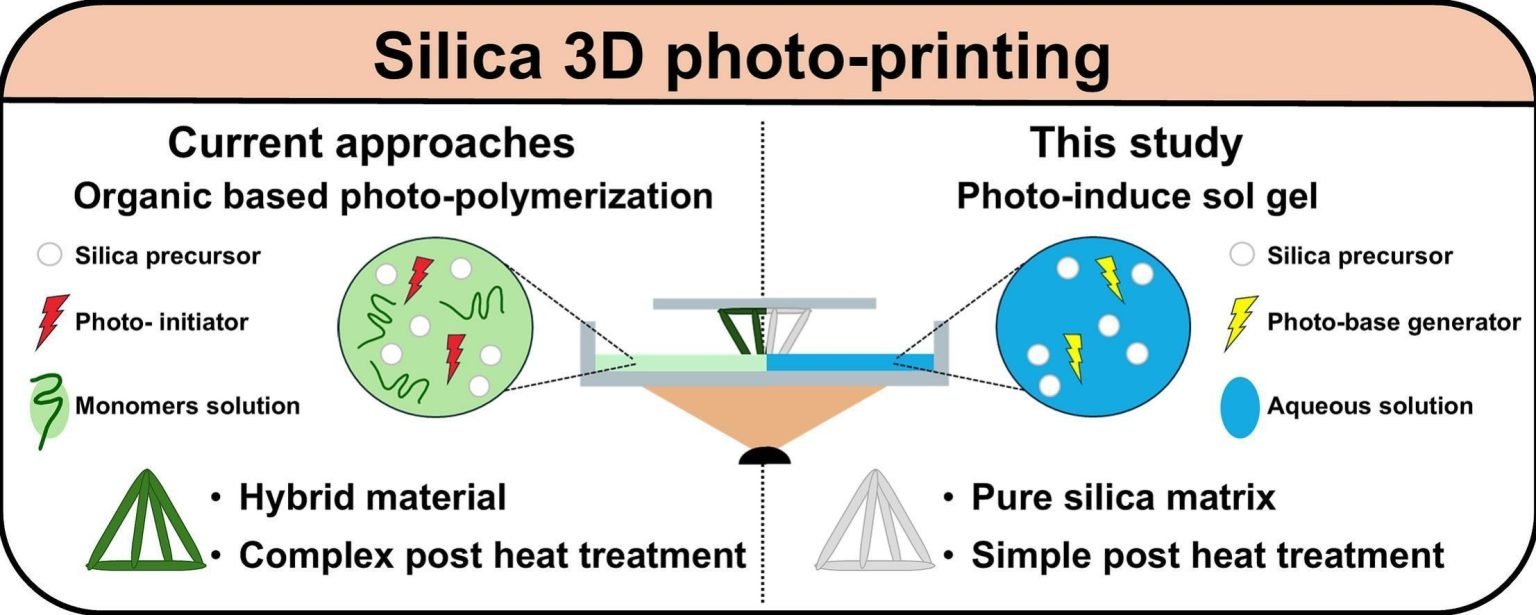
Researchers at the Hebrew University of Jerusalem have developed a stereolithography (SLA)-based 3D printing process for silica glass that operates entirely without organic binders. The study, published on ScienceDirect, demonstrates the fabrication of centimeter-scale mesoporous silica structures through photo-induced sol-gel reactions, using only inorganic precursors and low-cost digital light processing (DLP) equipment. The process eliminates the need for the conventional high-temperature debinding stage by achieving full condensation of silica networks at just 250 °C under vacuum, resulting in moderate transparency, minimal shrinkage, and structural purity approaching theoretical SiO₂ composition.

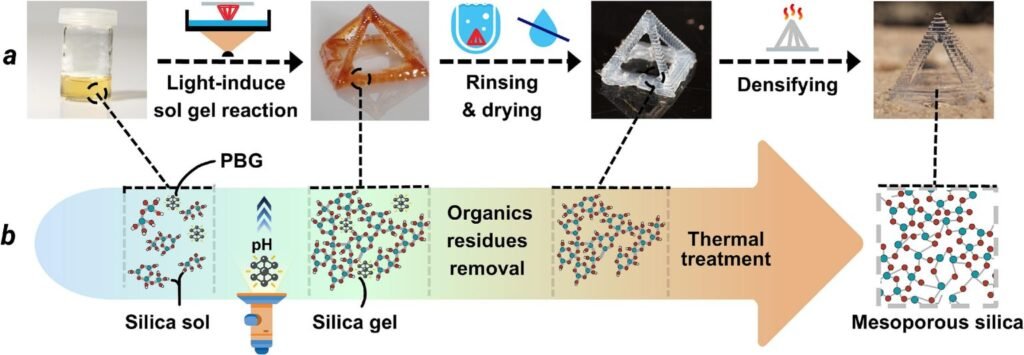
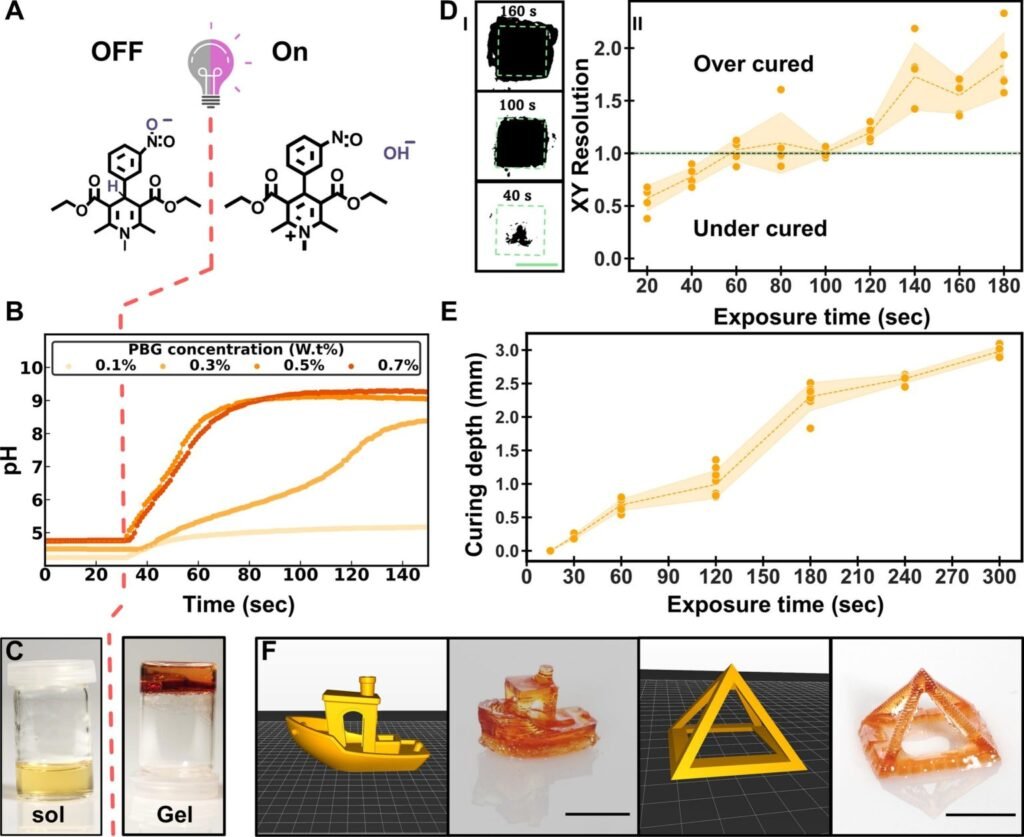
The method replaces photopolymer resins with a sol-gel chemistry initiated by a photo-base generator (PBG), specifically N-methyl nifedipine. When exposed to light at 405 nm and 26.0 mW cm⁻², the PBG decomposes to release hydroxide ions, locally increasing pH and triggering condensation of hydrolyzed tetraethyl orthosilicate (TEOS). Printing was performed on an Asiga MAX DLP printer equipped with a 385 nm LED source, using 0.3 mm layer thickness, 100-second exposure per layer, and a 180-second hold time to ensure interlayer adhesion. The composition contained 0.5 wt % PBG, found to be optimal for stable and rapid gelation. After printing, objects were rinsed in ethanol at 100 °C for seven days to remove residual organics before being dried via supercritical CO₂ (SAMDRI-PVT-3D) to prevent cracking caused by capillary stress.

Binder-free silica fabrication through sol-gel chemistry

Conventional SLA glass printing methods typically disperse silica nanoparticles within organic photopolymerizable resins. These binders require oxidative removal above 600 °C, a process prone to structural defects and incomplete decomposition. Alternative binder-free approaches using hydrogen silsesquioxane or two-photon polymerization have been restricted to sub-millimeter geometries or require post-processing near 800 °C. The new method avoids these constraints by employing direct sol-gel reactions under ultraviolet irradiation, without organic monomers or sacrificial components.

Hydrolyzed TEOS, ethanol, and distilled water in acidic conditions (pH ≈ 3) form the reactive matrix. Upon irradiation, N-methyl nifedipine produces hydroxide ions that locally shift the environment to basic conditions (pH ≈ 9), accelerating siloxane condensation. This controlled gelation mechanism allows spatially confined polymerization, enabling full 3D object formation rather than quasi-2D or nanoscale structures typical of prior binder-free techniques. The printed gels remain stable without spontaneous curing for at least one week in the absence of light, confirming precise reaction control.

Structural analysis and material performance

Post-processing under vacuum (5 × 10⁻² mbar) at 250 °C for 48 hours resulted in dense, amorphous silica networks confirmed by X-ray diffraction. CHNS/O analysis showed complete removal of carbon residues after ethanol rinsing at 100 °C, with carbon content below 0.3 wt %. Energy-dispersive X-ray spectroscopy revealed progressive condensation as the Si:O ratio decreased from 3.5 ± 0.3 in the rinsed gel to 2.6 ± 0.3 at 250 °C, reaching 2.1 ± 0.1 at 900 °C—nearly identical to pure silica. Solid-state ²⁹Si NMR spectra confirmed the transition from Q² and Q³ species to predominantly Q⁴, with a 143 % increase in Q⁴ under vacuum compared to air treatment, indicating greater network crosslinking.

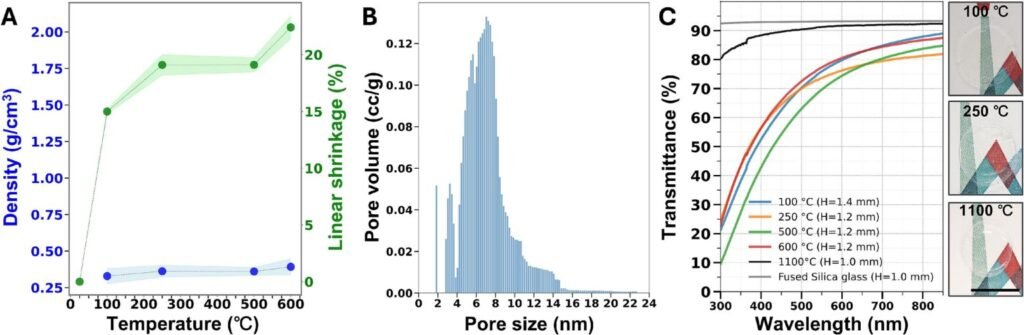
Printing tests produced one-centimeter-scale models, including a “3D Benchy” calibration boat and a hollow pyramid. Total printing time was about 2.5 hours, with the full processing cycle—including rinsing, drying, and annealing—taking approximately 10 days. Dimensional measurements across five disks indicated overall linear shrinkage of ≈ 25 %, with most contraction (15 %) occurring during ethanol heating, followed by minor reductions at 250 °C (+ 5 %) and 600 °C (+ 5 %). Density reached 12 % of fused silica (2.20 g cm⁻³) at 250 °C and 18 % at 600 °C, consistent with partial densification of a mesoporous structure.

Nitrogen adsorption–desorption analysis (BJH method) revealed pore sizes primarily between 4 and 8 nm. UV–Vis transmittance tests showed 80 % optical transmission in the 565–750 nm range for samples treated up to 600 °C. Further annealing at 1100 °C increased transparency to levels comparable with commercial fused silica glass (Suprasil 2B). Atomic force microscopy measurements indicated surface roughness of 71 ± 57 nm after 250 °C treatment, suggesting that densification initiates at the surface while internal porosity remains.

Functional materials and future developments

A proof-of-concept experiment embedded 0.5 wt % methylene blue into the sol mixture to test compatibility with temperature-sensitive organic compounds. The fluorescent dye remained stable and emissive after processing at 250 °C, confirming that the binder-free route preserves incorporated organic materials—something not possible in conventional high-temperature methods.

This research demonstrates a fully inorganic stereolithography method for silica that eliminates both photopolymer resins and high-temperature binder removal. By achieving structural condensation at 250 °C under vacuum, the process drastically reduces energy demand while maintaining centimeter-scale geometric fidelity. The approach provides a foundation for extending binder-free SLA to other sol-gel systems such as zirconium or titanium alkoxides, with potential applications in photonics, microfluidics, and biomedical engineering.

*This article originally appeared on 3D Printing Industry. ANYER TENORIO LARA is the original author of this piece.

Have parts to make? Get free instant quote today.

Share the Post:

Related Posts

Knowledge Base
Protecting mechanical processing parts with “armor”: Comprehensive analysis of galvanizing surface treatment process, advantages and disadvantages, and application selection

Abstract: In the field of mechanical manufacturing, the durability of parts directly determines the lifespan and reliability of the products. Galvanization, as a classic, efficient, and cost-effective metal surface treatment process, provides excellent rust and corrosion protection for steel parts. This article will deeply explore all aspects of galvanizing for mechanical processing parts, including its core principles, detailed comparisons of various processes (electro-galvanizing, hot-dip galvanizing, mechanical galvanizing, etc.), the protective mechanism of the galvanized layer, advantages and disadvantages analysis, subsequent treatments (such as passivation, phosphating), quality inspection standards, and how to select the most suitable galvanizing process based on the characteristics of your parts, helping you equip precision-machined parts with the strongest “armor”.

Read More
Knowledge Base
Complete Guide to Part Polishing: From Process Principles to Application Effects, Comprehensive Analysis of CNC Metal Polishing Technology

In the field of precision manufacturing, part polishing is a crucial step that determines the performance, lifespan, and appearance of products. Whether it is the core components of automotive engines, the precise components of medical devices, or the micro parts of electronic equipment, after professional polishing treatment, not only can the surface smoothness be improved, the friction loss be reduced, but also the corrosion resistance be enhanced, laying a solid foundation for subsequent assembly and use. This article will start from the basic understanding of part polishing, deeply analyze the mainstream polishing processes, material adaptation schemes, common problem solutions, equipment selection techniques, and industry development trends, providing comprehensive and practical reference guidelines for manufacturing enterprises, technicians, and procurement professionals.

Read More

Join our newsletter to stay updated

Scroll to Top